


I spent the last few weeks pulling every number I could find on where AI money actually went this year.
The result is a 23-slide deck.
I’m publishing it here in full, slide by slide, with the story behind each one.
The short version: 2026 was simultaneously the biggest gold rush in venture history and the year reality caught up with the hype. Both things are true.
The full deck is at here: share it freely.

Now, the breakdown:
AI outlook for 2026
Sequoia Tech Waves and what's the next wave
How electricity becomes key bottleneck
Fastest growing AI startup verticals
Why companies are not seing ROI from AI
Five AI investment bets every VC and founder should have in mind
PS: In case you missed, check out The AI Rollup Playbook: Why Buying a Boring Business and Running It With AI Agents Is the Best AI Bet of 2026

Onwards!
1. Gold
Rush & Reckoning
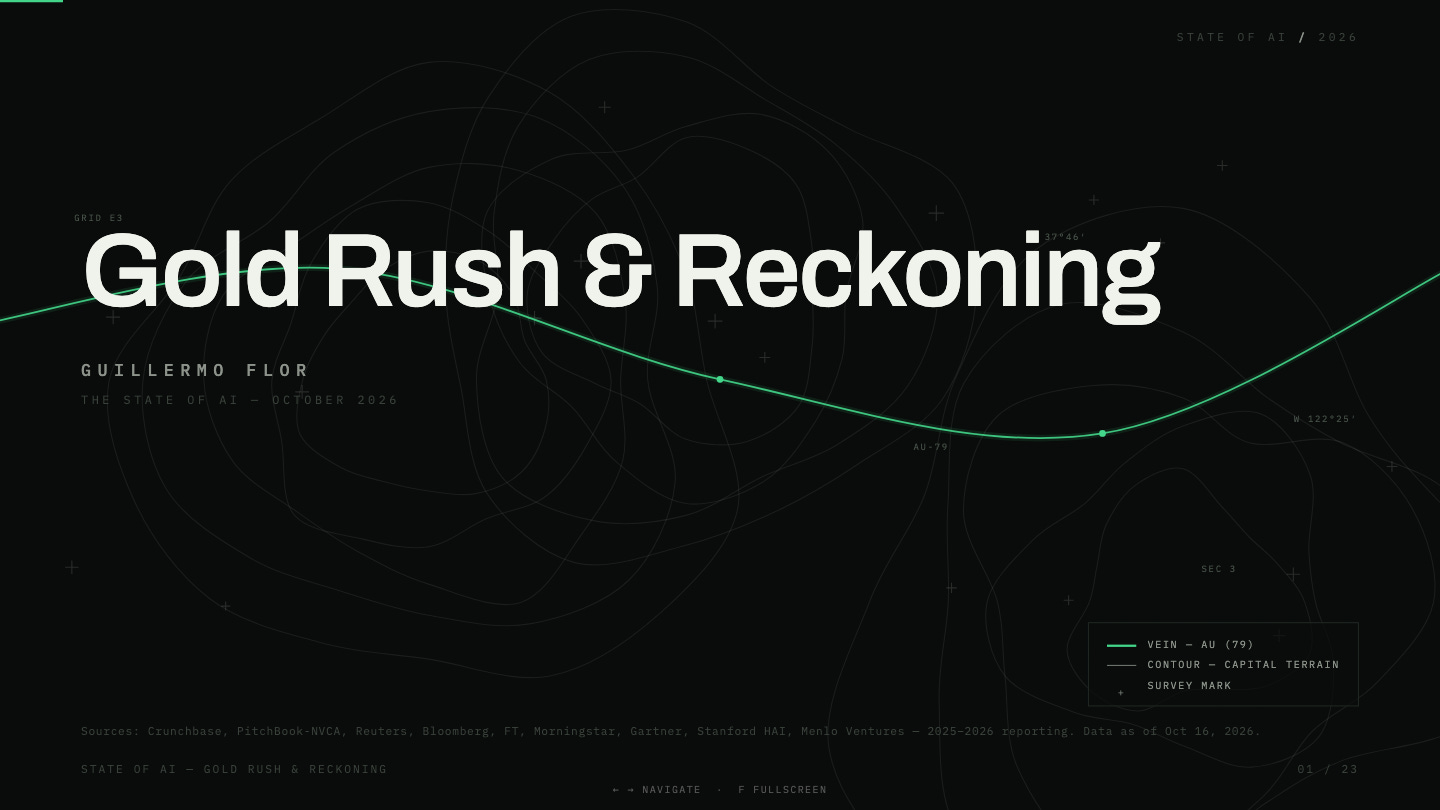
The theme of the deck. The money pouring into AI has no precedent and neither does the gap between companies deploying AI and companies getting value from it. Every number that follows is sourced and current as of this week.
2. 2026 was the most capital-concentrated year in VC history: $679B in nine months
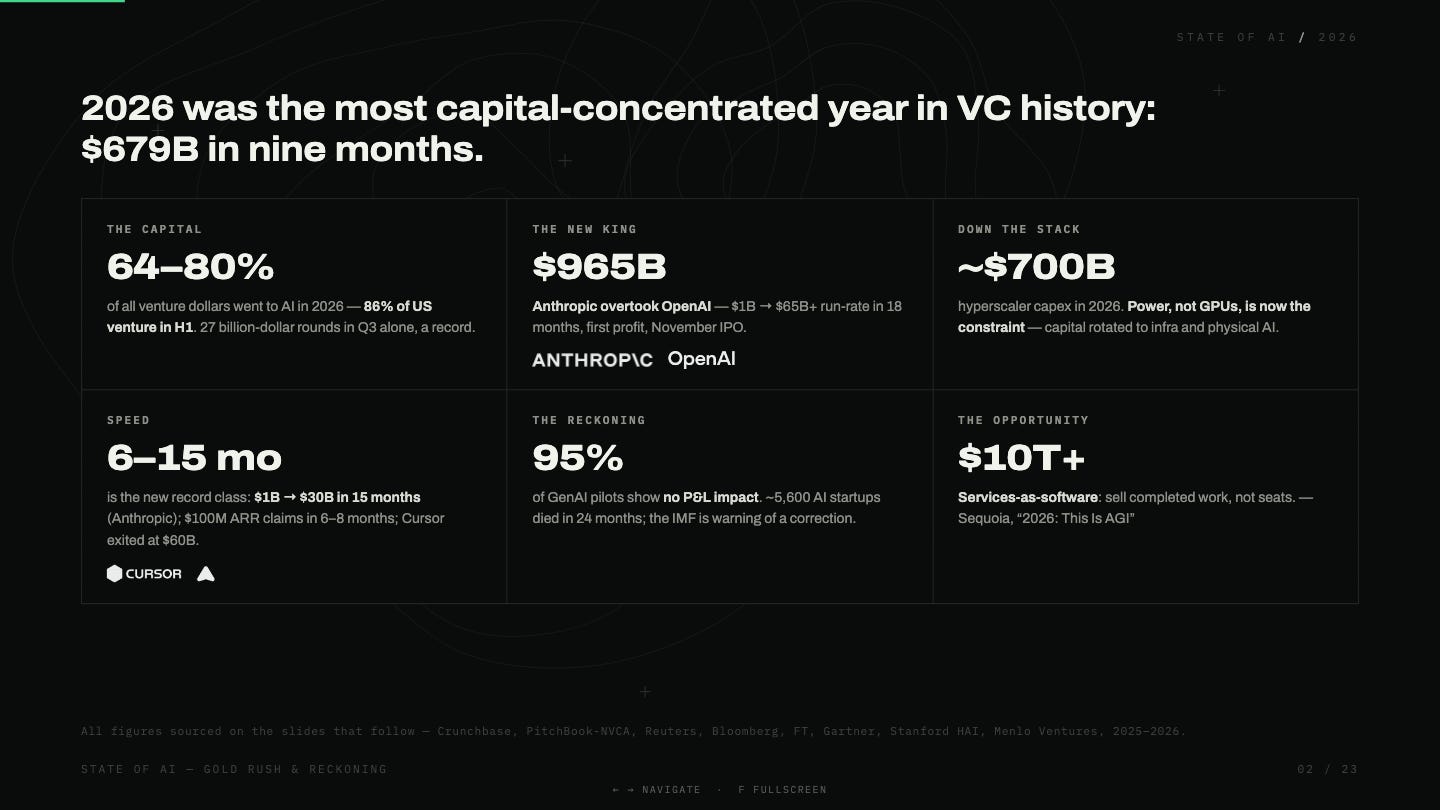
The whole story in six tiles. $679B of venture in nine months, up to 80% of it into AI. Anthropic passed OpenAI and goes public in November. Hyperscalers are spending ~$700B this year, and the bottleneck is electricity now, not chips. Growth records kept falling while ~5,600 AI startups died. The opportunity: sell work, not software.
3. Every technology wave minted more value than all waves before it. AI is the steepest yet.
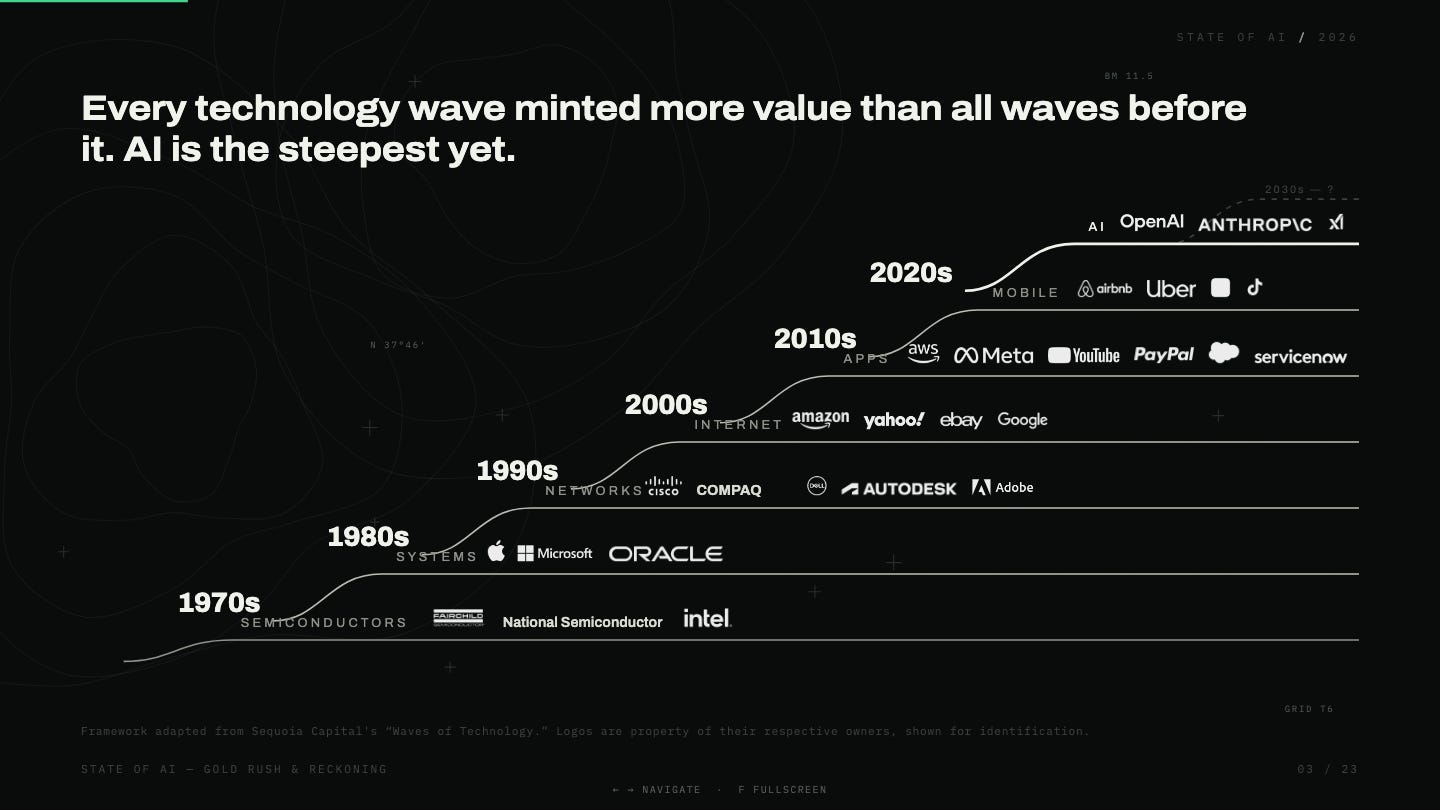
Sequoia’s classic framework, updated. Semiconductors, systems, networks, internet, apps, mobile. each wave was worth more than everything before it, and each was built on the previous one. AI is the seventh wave, and its adoption curve is steeper than any of them. The logos tell the story of who captured each wave.
4. The Gold Rush
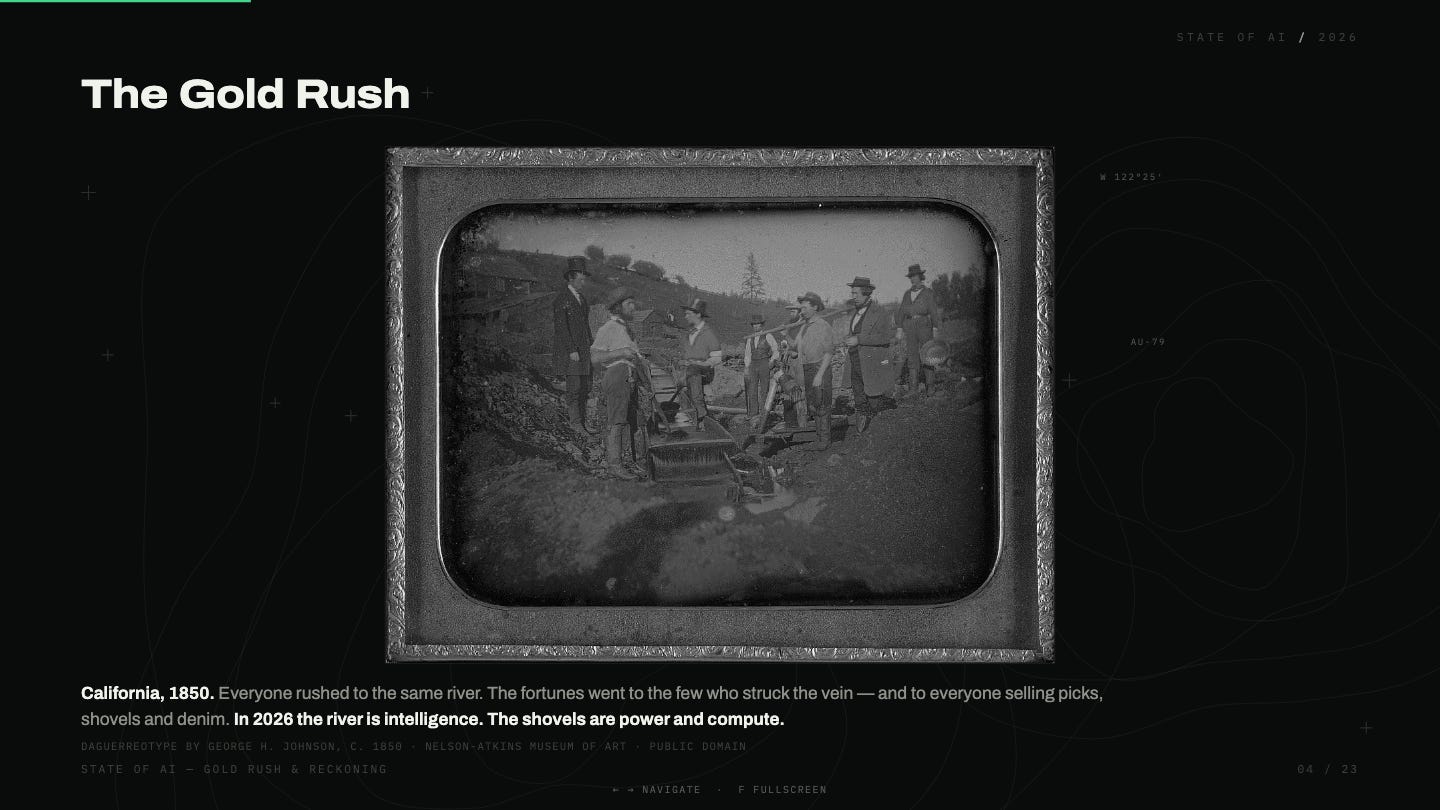
California, 1850. A few miners struck the vein; most went home with nothing. The people who reliably got rich sold picks, shovels and denim, Levi Strauss never touched a pickaxe. The structure is identical today: the river is intelligence, the shovels are power and compute, and the denim is deployment.
5. AI took up to 80 cents of every venture dollar in 2026
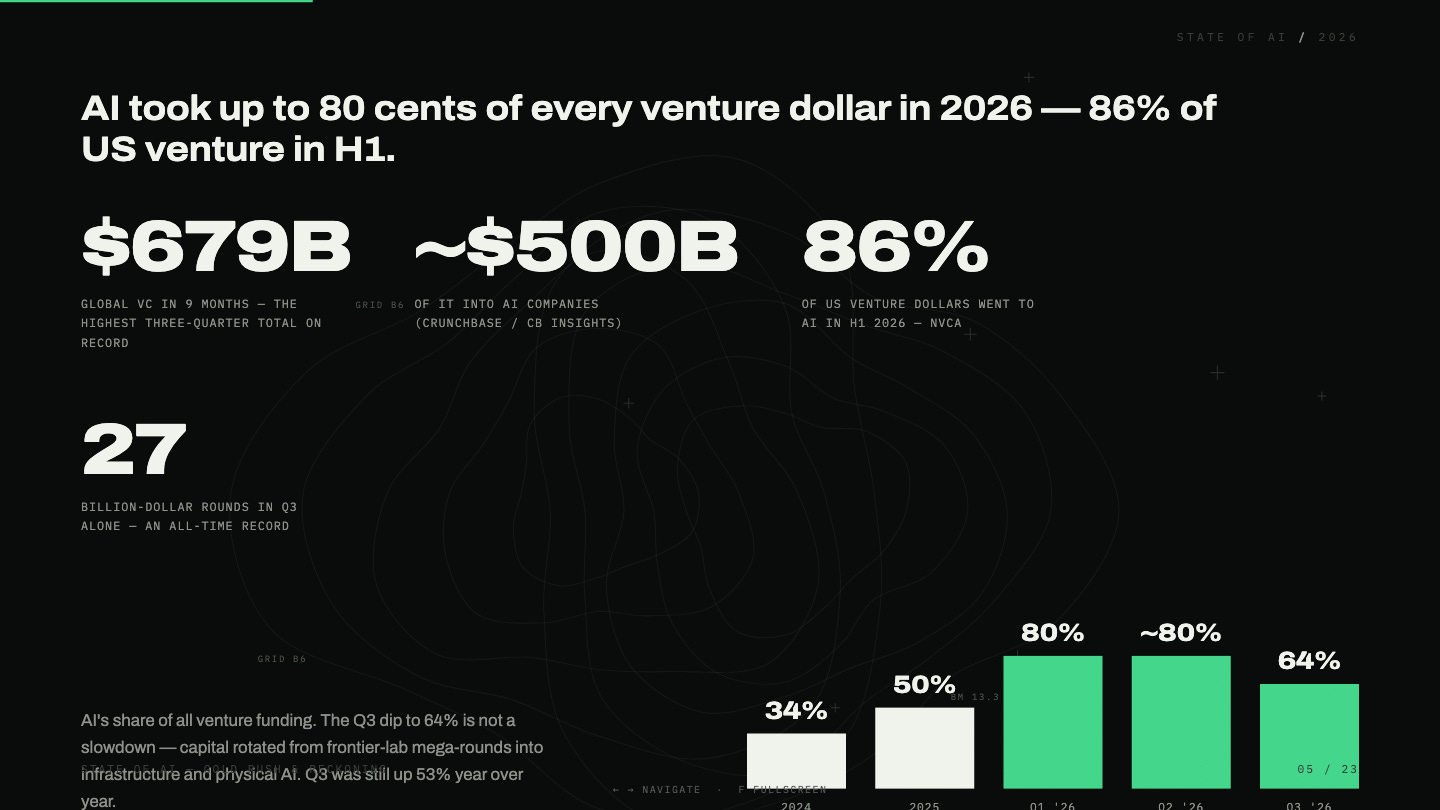
AI’s share of all venture funding went from 34% in 2024 to 80% in early 2026. The Q3 dip to 64% isn’t a slowdown, Q3 was still up 53% year over year. The giant lab rounds closed in the first half, then capital rotated into infrastructure and physical AI. The money didn’t leave. It moved.
6. Four companies raised 65% of all venture capital on Earth in one quarter
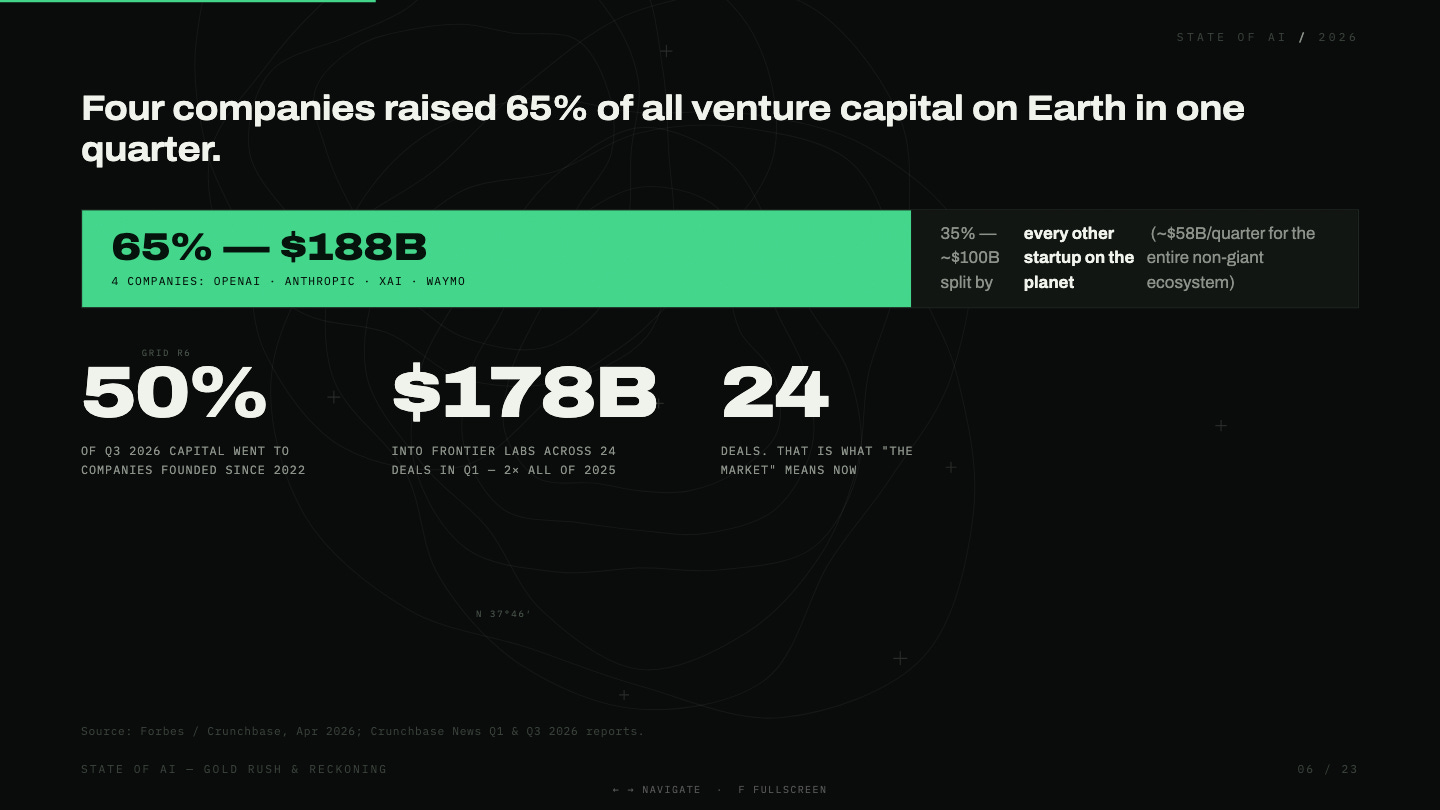
OpenAI, Anthropic, xAI and Waymo raised $188B in Q1, 65% of all venture capital on the planet. Every other startup split the rest. If you’re building outside that club, this is the weather you’re operating in.
7. OpenAI’s $122B is the largest private round in history
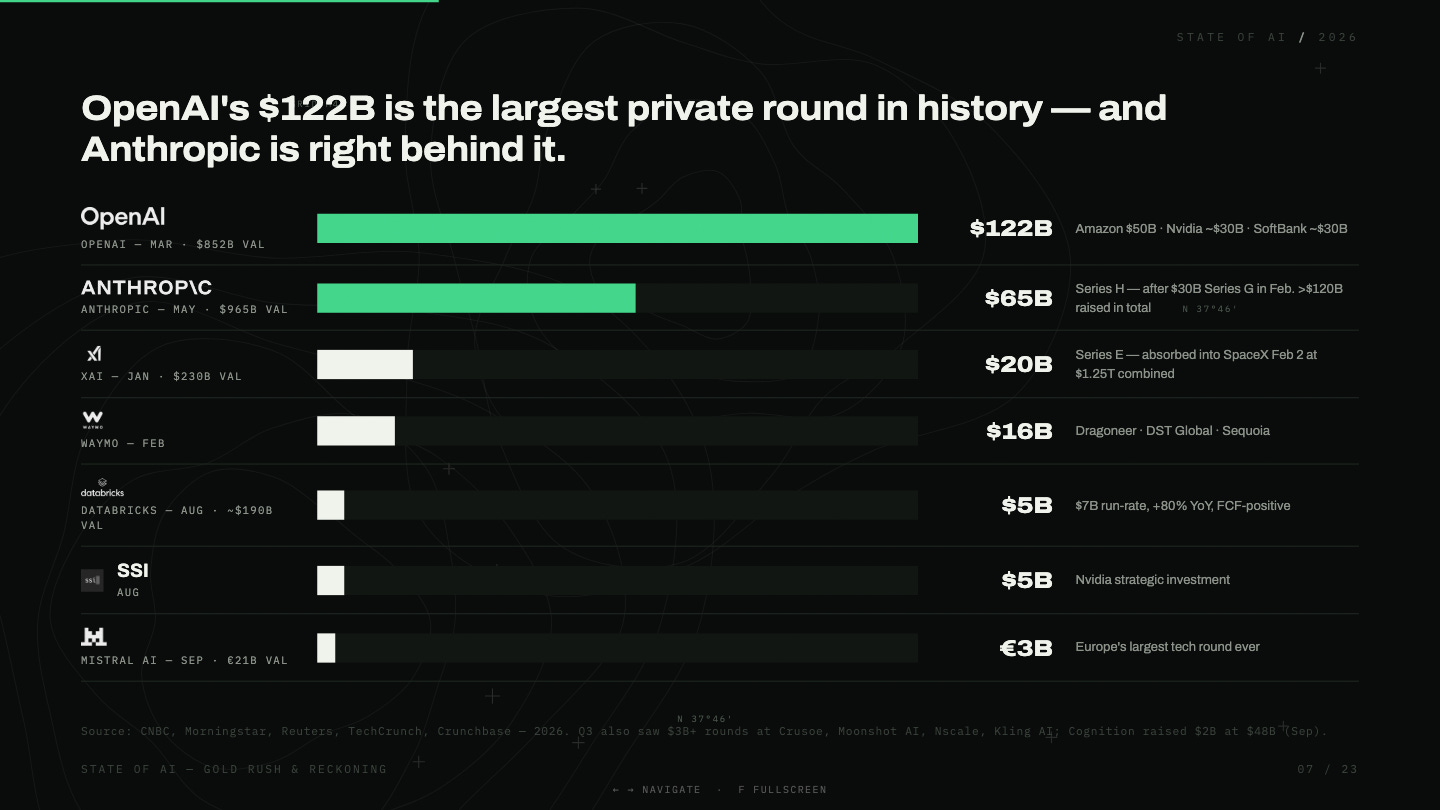
Amazon wrote $50B of it; Nvidia and SoftBank about $30B each. Anthropic’s $65B Series H in May was its second mega-round of the year, at a $965B valuation. Below those two, the drop-off is steep, the top two bars are a different species from everything else.
8. The seed round became a $1B game for famous names
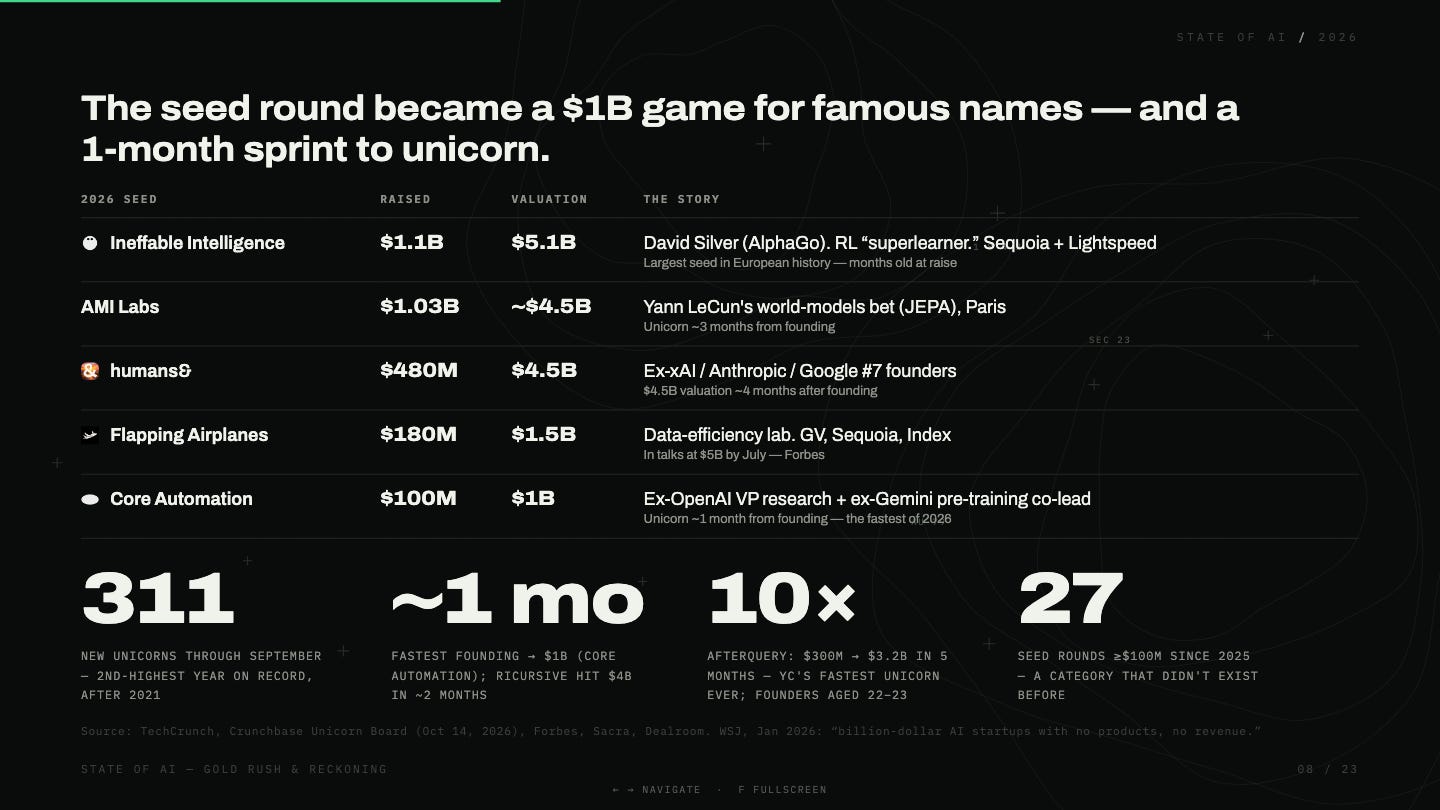
David Silver (AlphaGo) raised a $1.1B seed (the largest in European history) for a company that was months old. Yann LeCun’s new lab raised $1.03B three months after founding. Core Automation was a unicorn one month after incorporating. 311 new unicorns were minted through September, the second-highest year ever, after 2021.
9. Anthropic overtakes OpenAI: $1B → $65B+ in eighteen months
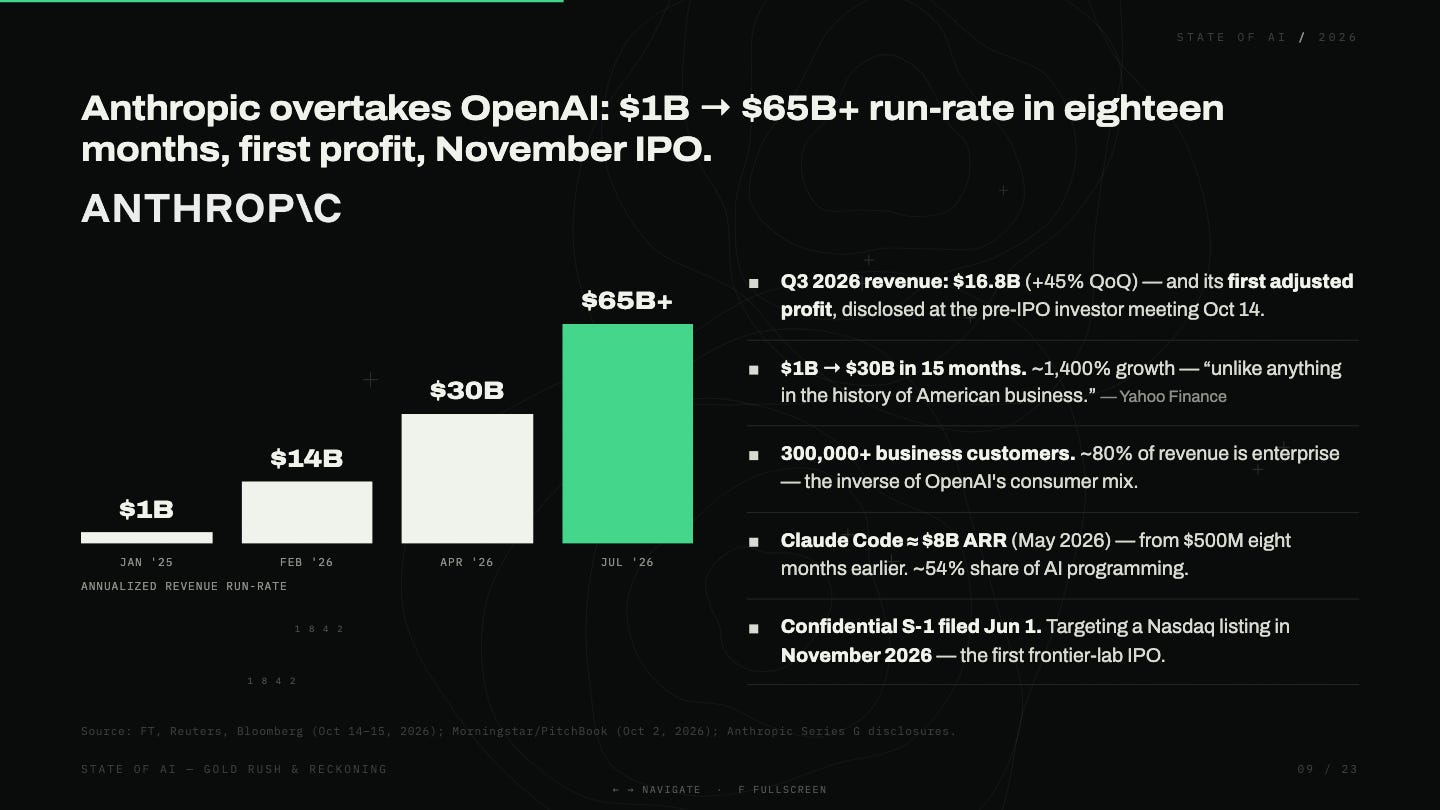
The company story of the year. $16.8B of revenue in Q3, up 45% quarter over quarter, with its first adjusted profit. 300,000+ business customers, 80% of revenue from enterprise. Claude Code alone is at ~$8B ARR and writes ~4% of public GitHub commits. The S-1 is filed; November is the target. That IPO matters for everyone, it’s the first audited look at frontier-lab economics.
10. OpenAI is still enormous. It is also suddenly second.
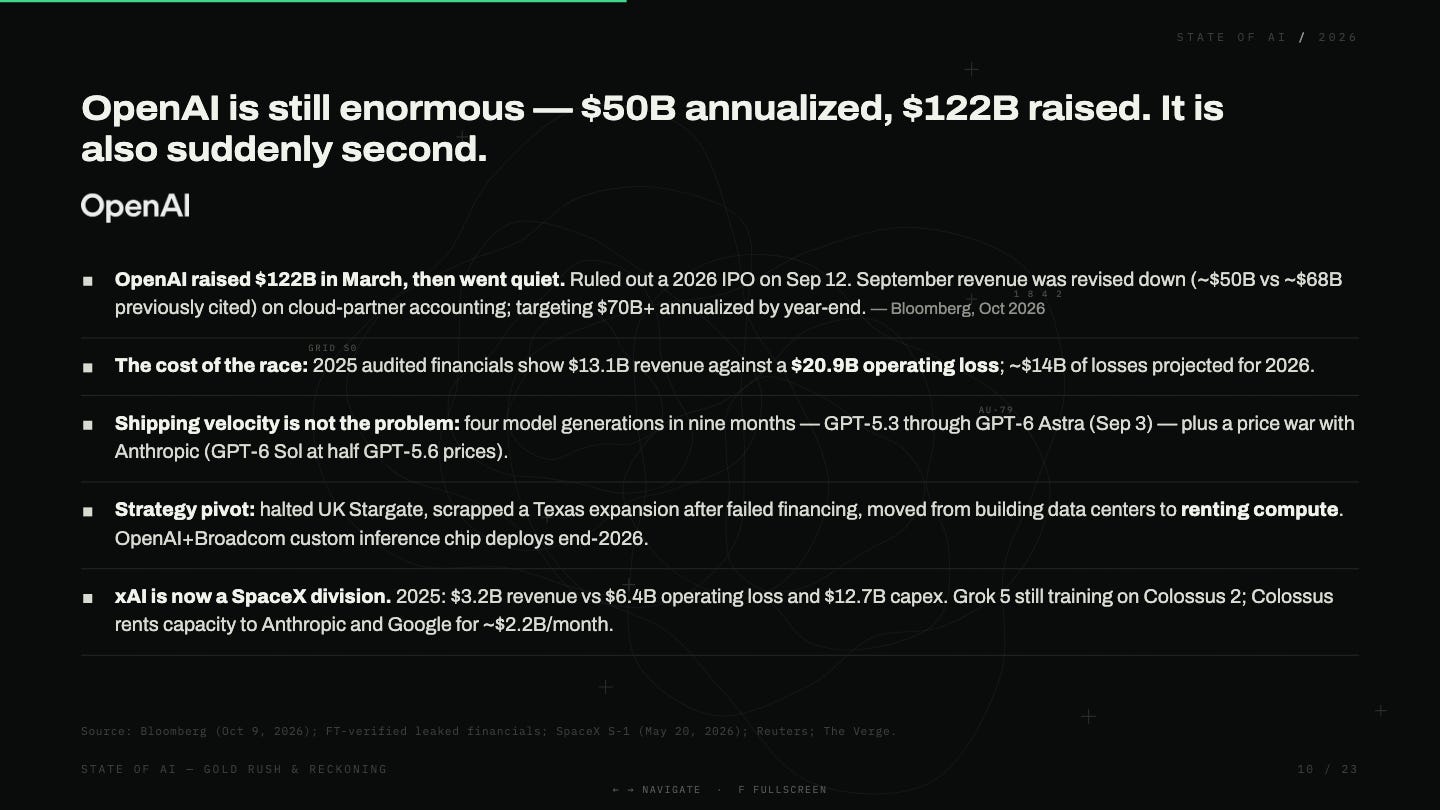
~$50B annualized, $122B raised in March and then quiet: no 2026 IPO, and September revenue revised down on accounting treatment. The leaked 2025 financials showed $13.1B of revenue against a $20.9B operating loss. They’re shipping fast and waging a price war with Anthropic, but the strategic tell is real: they stopped building data centers and started renting compute instead.
11. 2026 blew the exit window open
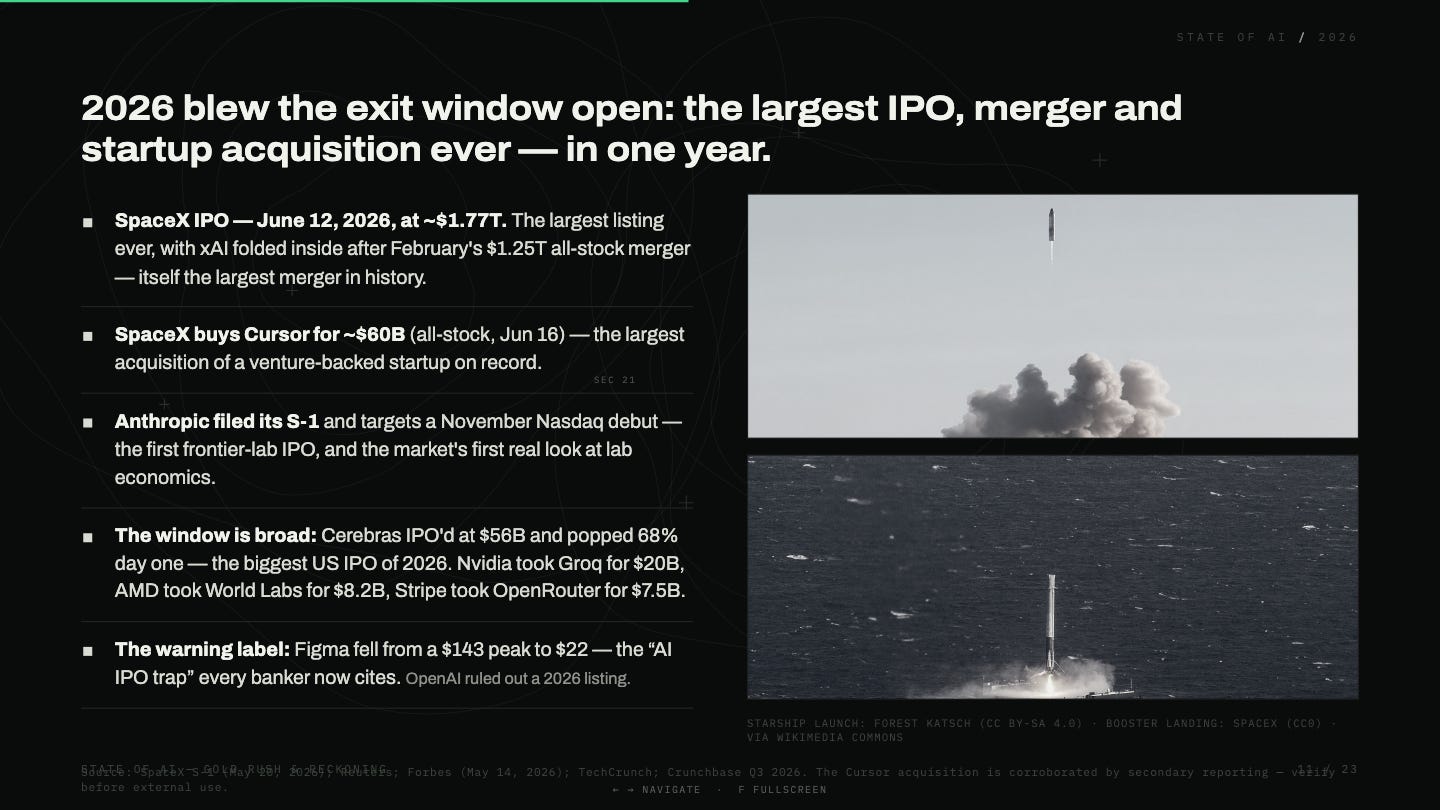
The largest IPO ever (SpaceX, $1.77T, with xAI inside), the largest merger ever ($1.25T, SpaceX–xAI), and the largest acquisition of a venture-backed startup ever (SpaceX buying Cursor for ~$60B) — all in one year. Anthropic files next. The warning label: Figma fell from $143 to $22. The window is open, but the market is picky about what it lets through.
12. Hyperscalers will spend ~$700B on AI in 2026 — and the constraint is now electricity, not chips
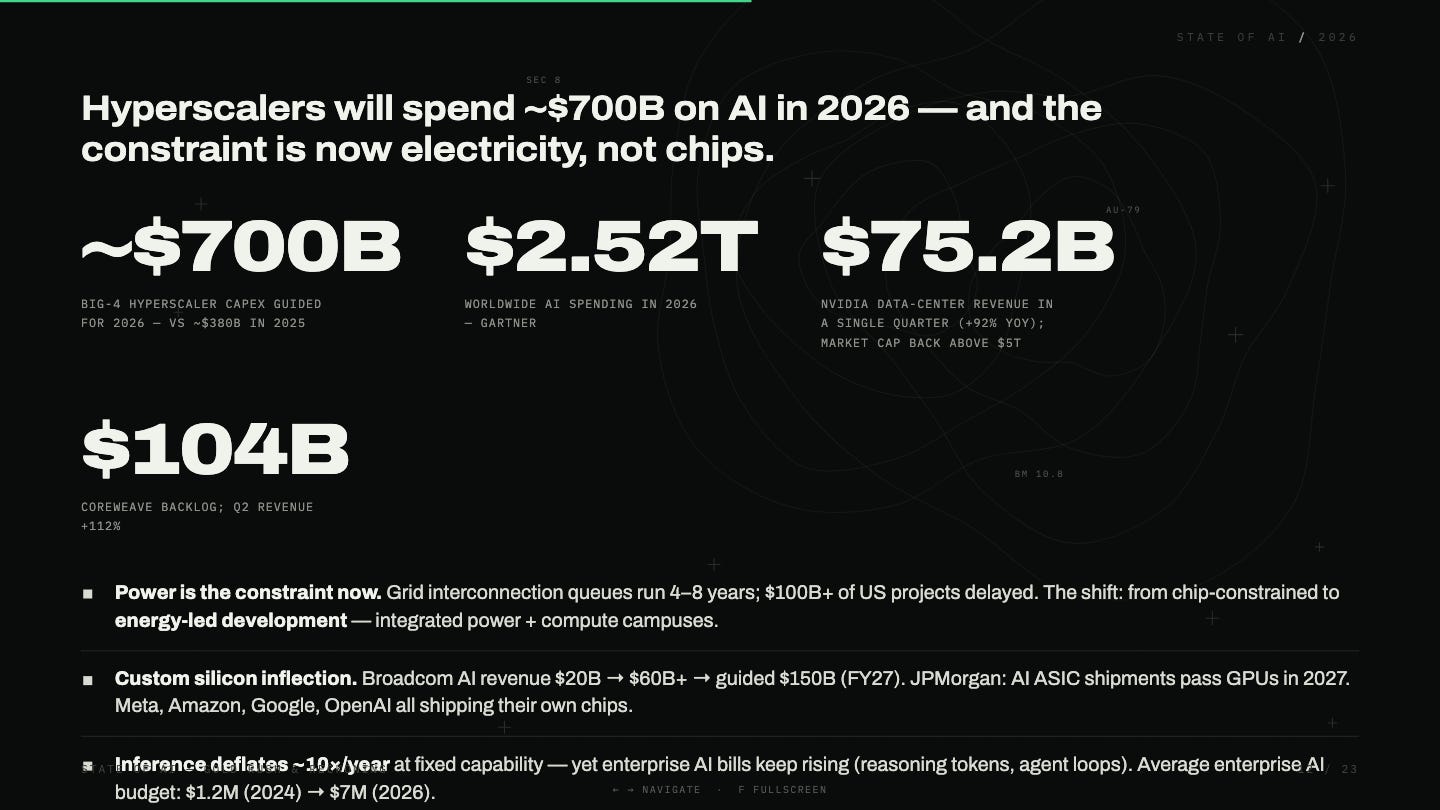
The four big hyperscalers nearly doubled capex this year. Nvidia did $75B of data-center revenue in a single quarter. But GPUs are cheap to rent now — what you can’t get is power. Grid queues run 4–8 years and $100B+ of projects are stuck waiting. That’s why everyone, from Meta to OpenAI, is suddenly designing their own silicon and buying energy-integrated campuses.
13. The New Constraint
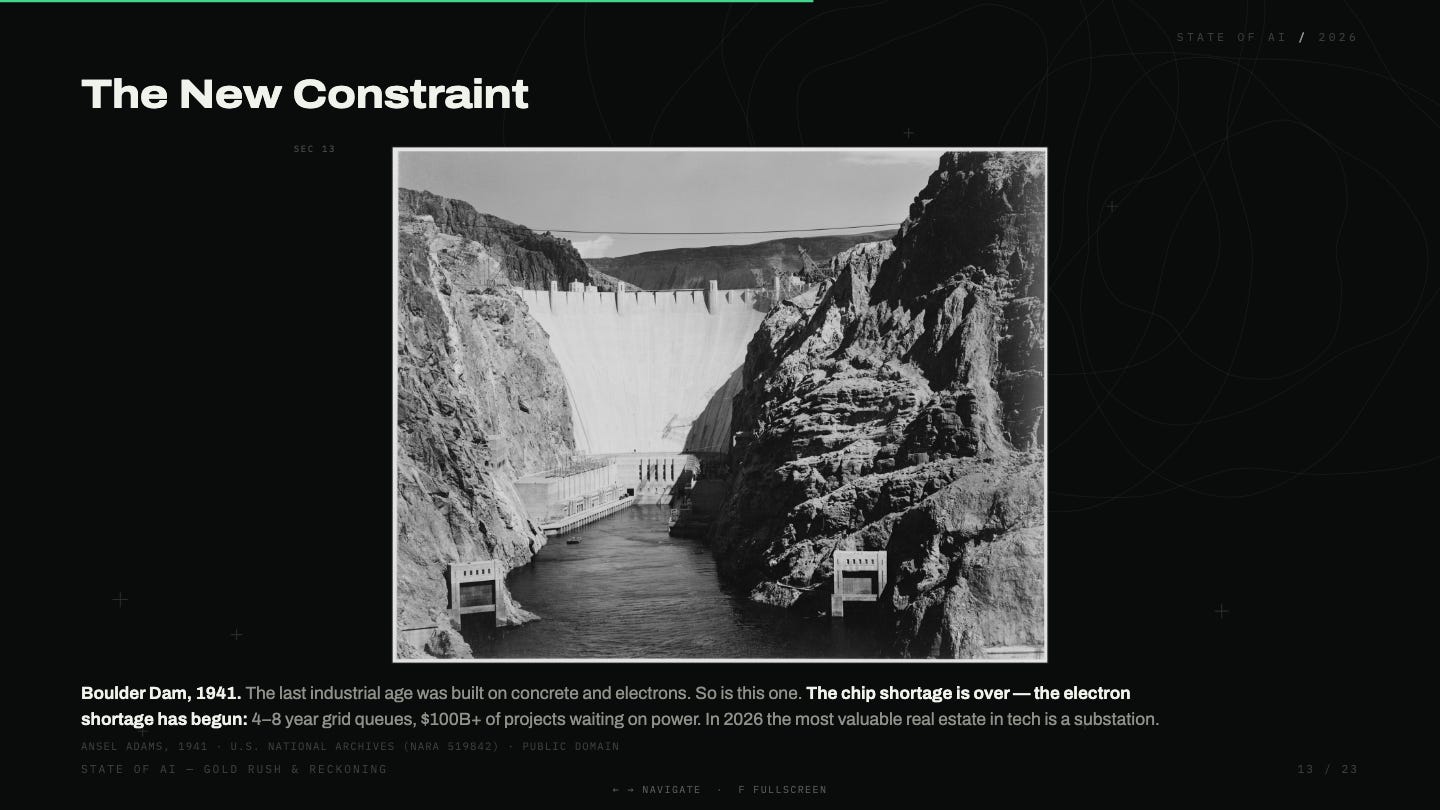
Ansel Adams shot Boulder Dam in 1941. The last industrial age ran on concrete and electrons; this one does too. The chip shortage is over. The electron shortage has begun. In 2026, the most valuable real estate in tech is a substation.
14. Coding is the breakout category — $8B ARR in eight months
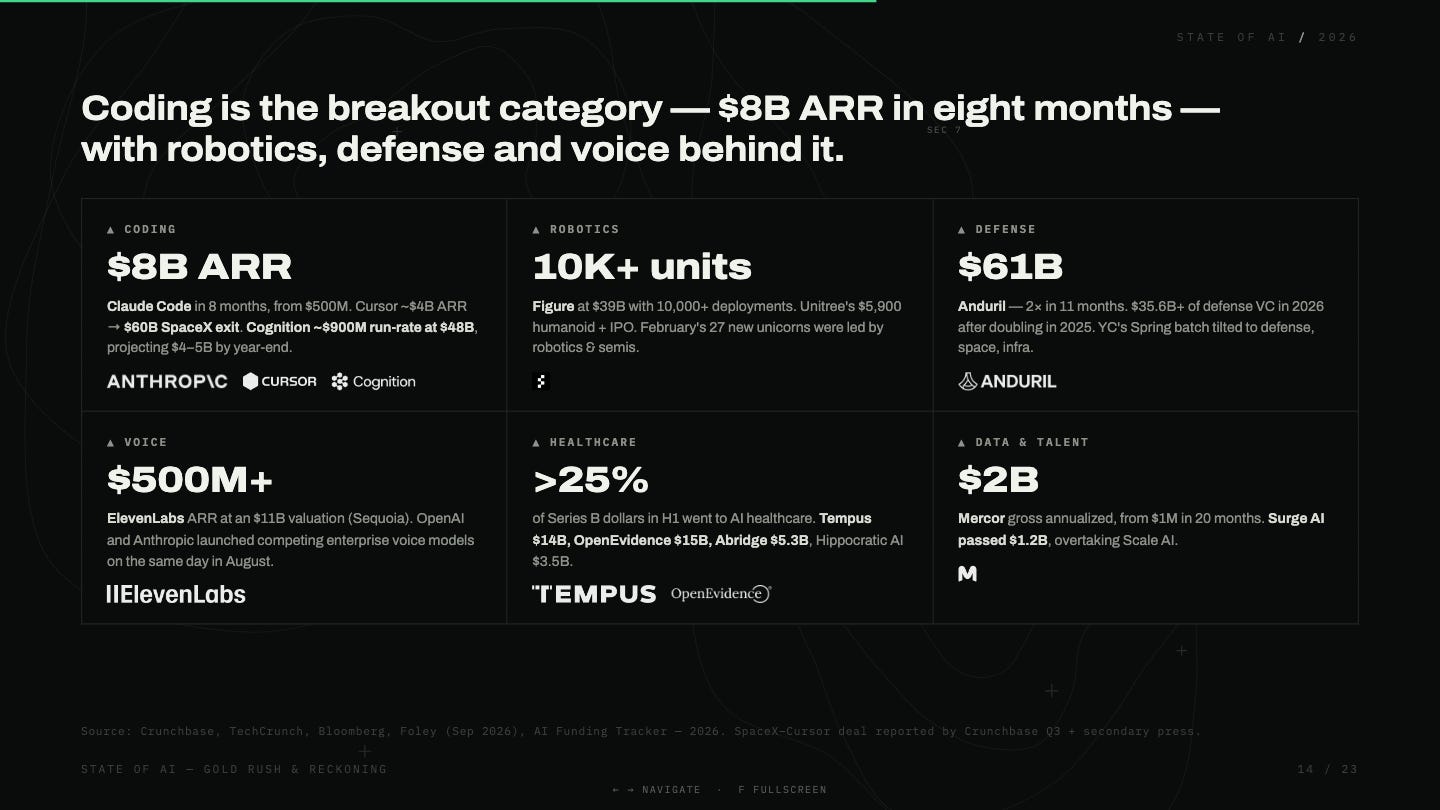
What’s actually working: coding (Claude Code $500M → ~$8B ARR in eight months; Cursor exited at $60B), robotics (Figure: 10,000+ deployments, $39B), defense (Anduril doubled to $61B in eleven months), voice (ElevenLabs past $500M ARR), healthcare AI (a quarter of Series B dollars). Notice the pattern: all of them sell completed work, not tools.
15. ~5,600 AI startups died in 24 months
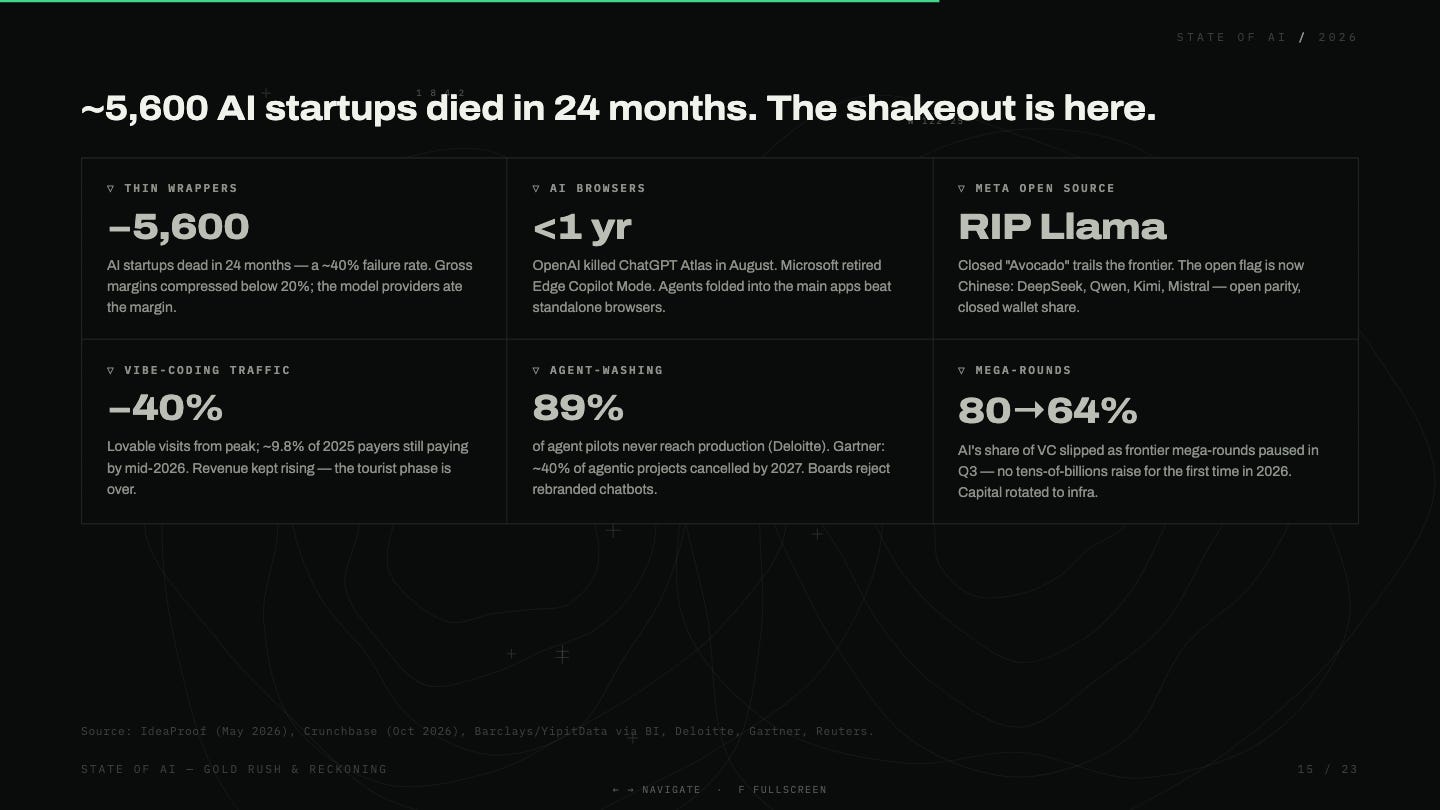
The shakeout, by the numbers: a ~40% failure rate, mostly thin wrappers whose margins got eaten by the model providers. OpenAI killed its browser before its first birthday. Meta gave up on open source. Vibe-coding traffic collapsed (Lovable is down 40% from peak). And 89% of agent pilots never reach production. The tourist phase is over.
16. AI companies now reach $100M ARR in months — the newest record claim is six
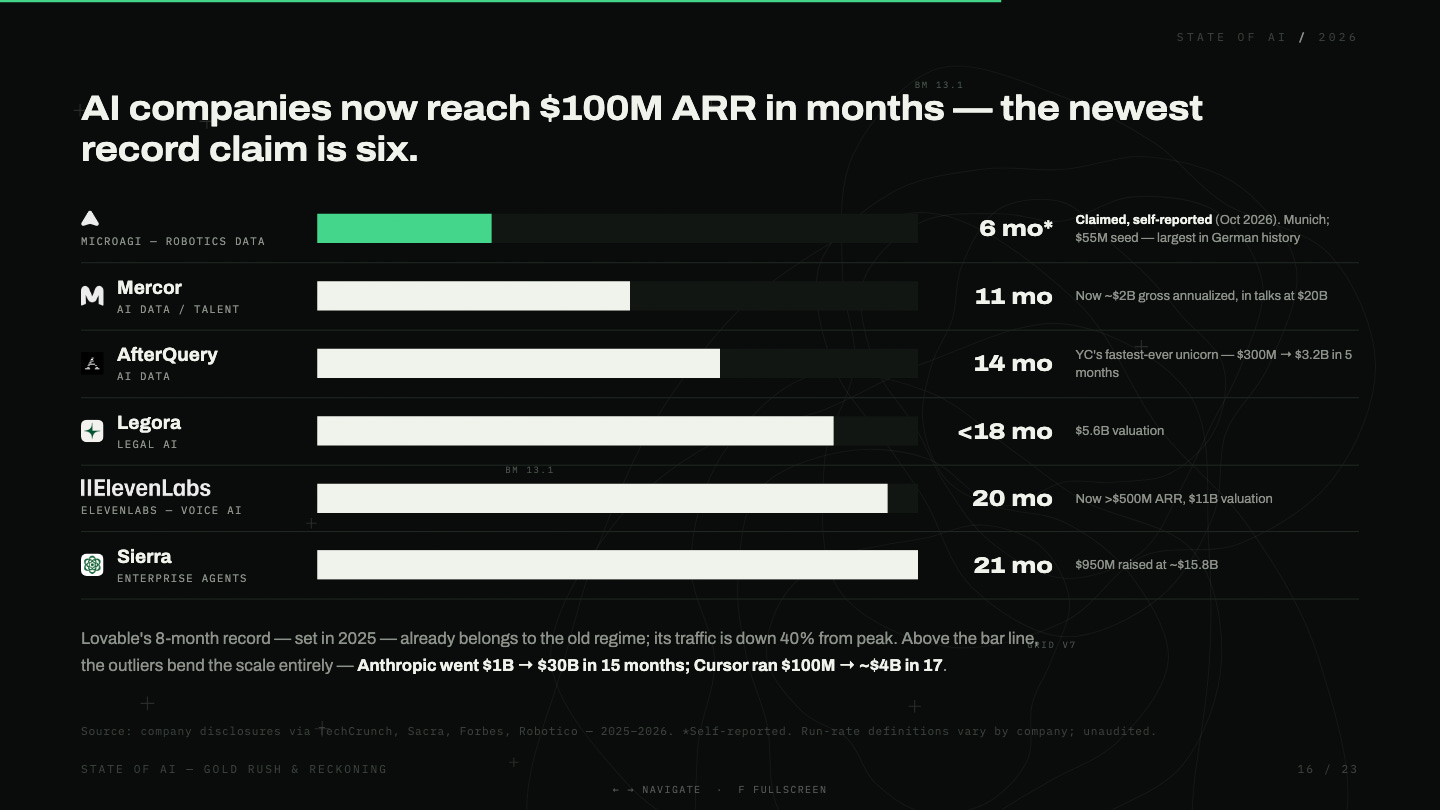
MicroAGI, a Munich robotics-data startup, claims $100M annualized six months after founding (self-reported — haircut accordingly). Mercor did it in 11 months, AfterQuery in 14 — YC’s fastest unicorn ever, with founders aged 22 and 23. For reference, the last SaaS generation measured this milestone in years. Lovable’s 8-month record from 2025 already feels like ancient history, which tells you the half-life of these records.
17. Eight more companies that defined 2026
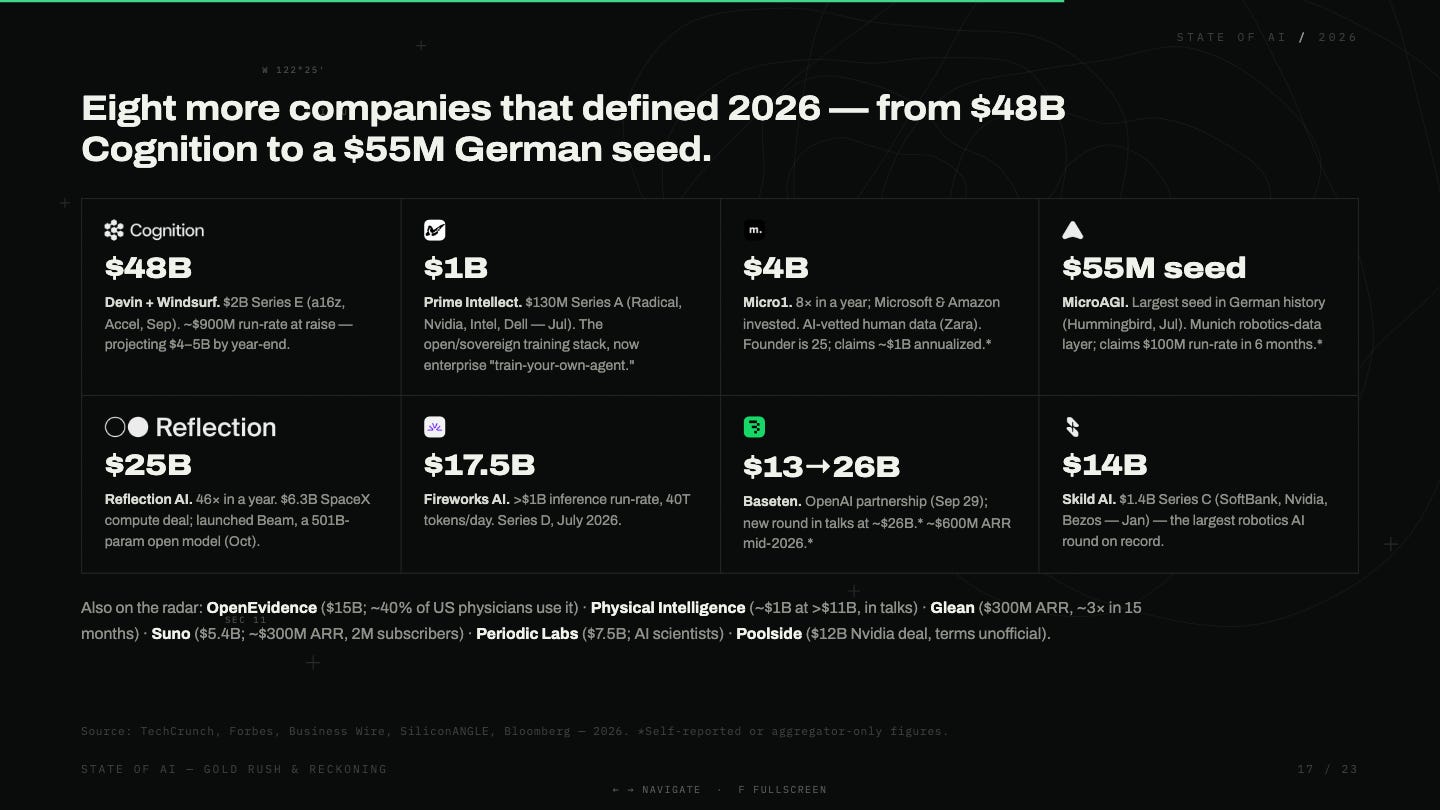
Cognition at $48B proves AI coding isn’t winner-take-all. Prime Intellect is the open training stack’s unicorn. Micro1 went 8x in a year with a 25-year-old founder. Reflection AI went 46x. Fireworks crossed $1B in inference revenue. Baseten signed OpenAI. Skild raised the biggest robotics AI round ever. Two years from now, some of these will be on the earlier slides — and some won’t exist.
18. The Cars Have Arrived
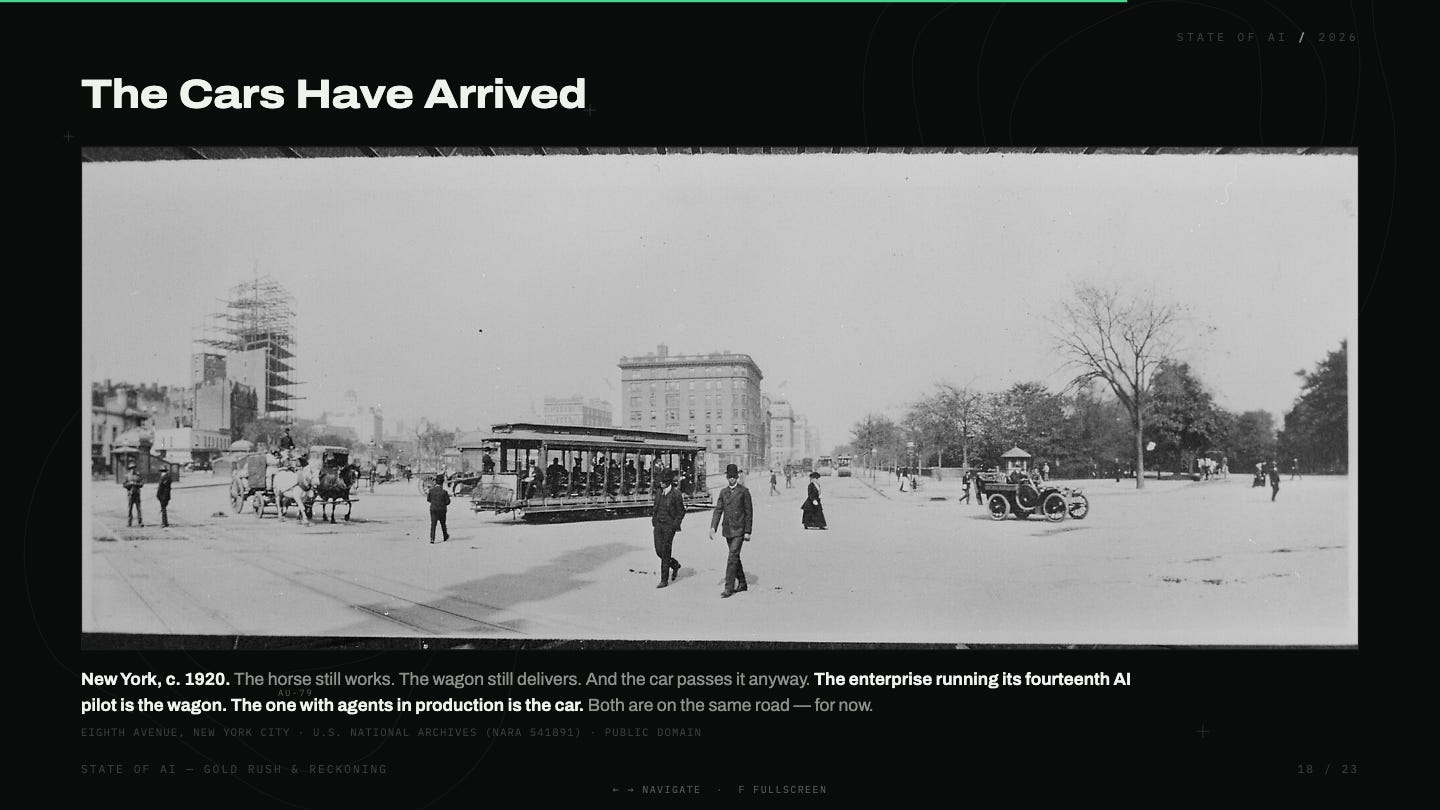
New York, around 1920: horse-drawn wagons and an early automobile sharing the same street. The horse still works. The car passes it anyway. Every enterprise is somewhere in this photo — the one running its fourteenth AI pilot is the wagon; the one with agents in production is the car.
19. 88% of organizations use AI — yet 95% of pilots show zero P&L impact
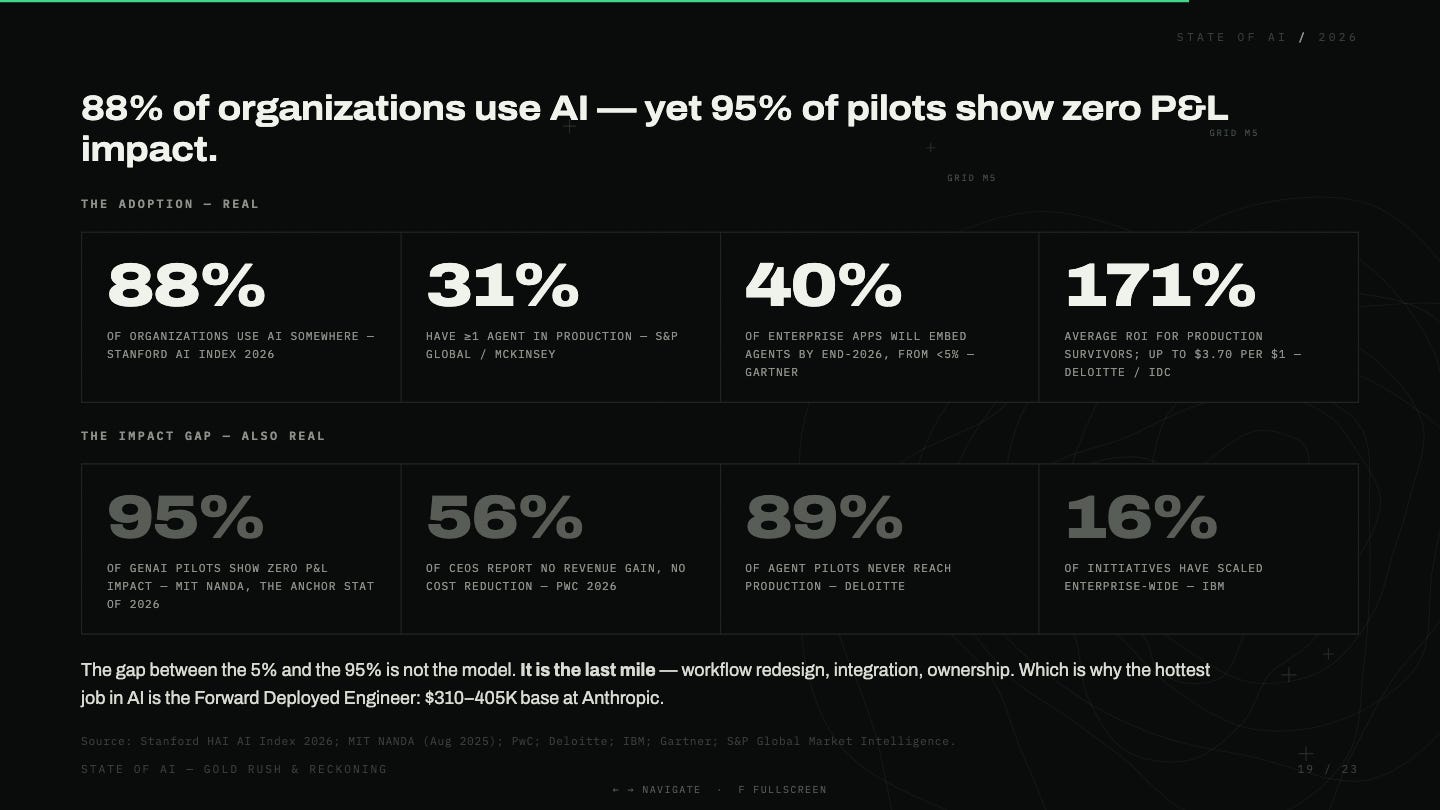
Both halves are true. Adoption is nearly universal, 31% of enterprises have an agent in production, and the companies that get it right see 171% ROI. But most pilots produce nothing measurable, and 56% of CEOs report no revenue gain and no cost savings from AI. The difference isn’t the model — everyone has the same models. It’s the last mile: workflow redesign, integration, ownership. That’s why Anthropic pays Forward Deployed Engineers up to $400K.
20. The IMF, the Bank of England and Michael Burry are all warning of an AI correction
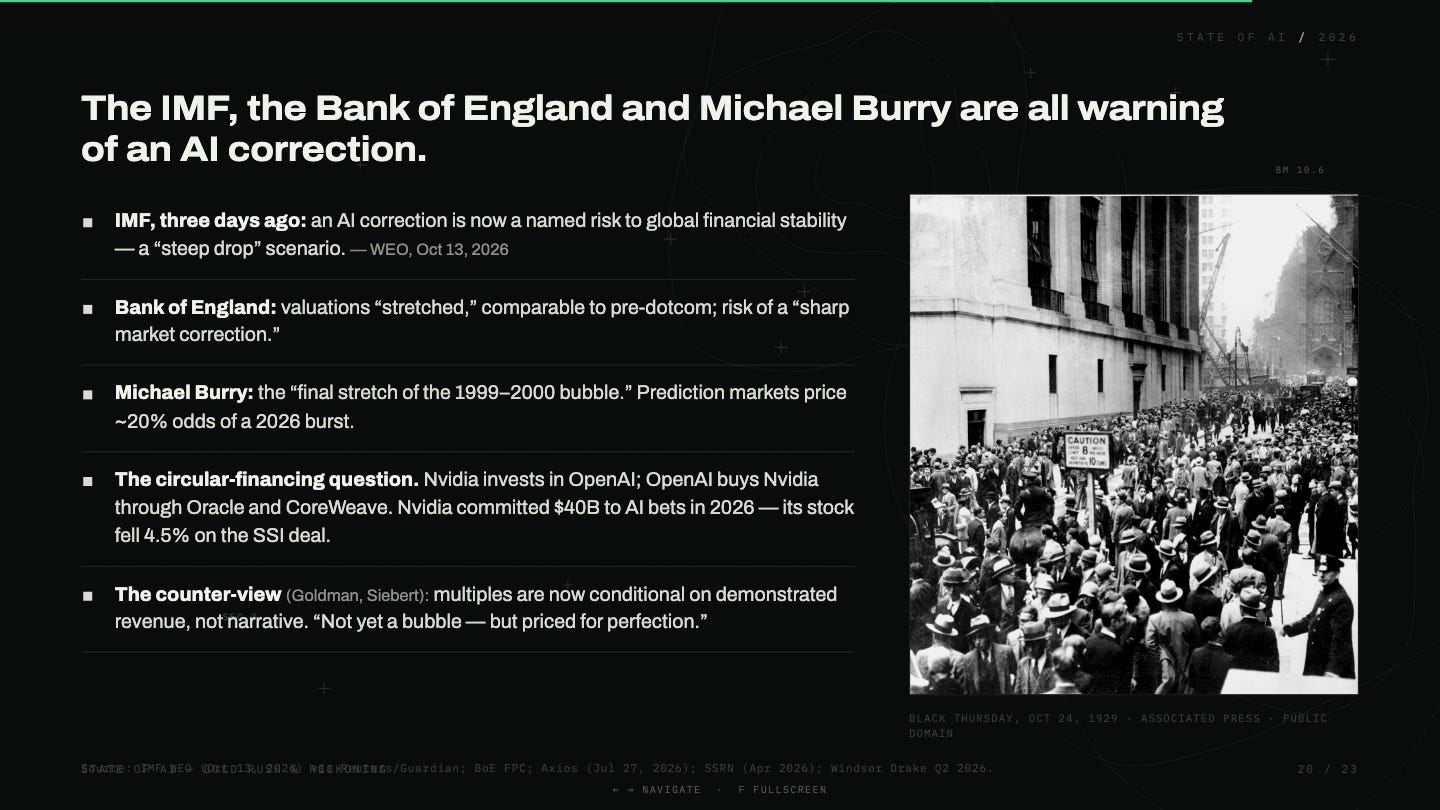
The IMF named an AI correction as a global financial-stability risk this week. The Bank of England compares valuations to pre-dotcom. Burry calls it the final stretch of 1999. The circular financing is the real thing to watch — Nvidia invests in OpenAI, OpenAI buys Nvidia through Oracle and CoreWeave. The counter-argument: unlike 1999, the leaders actually have revenue. My read: not a dot-com bubble, but priced for perfection.
21. Twelve Seconds
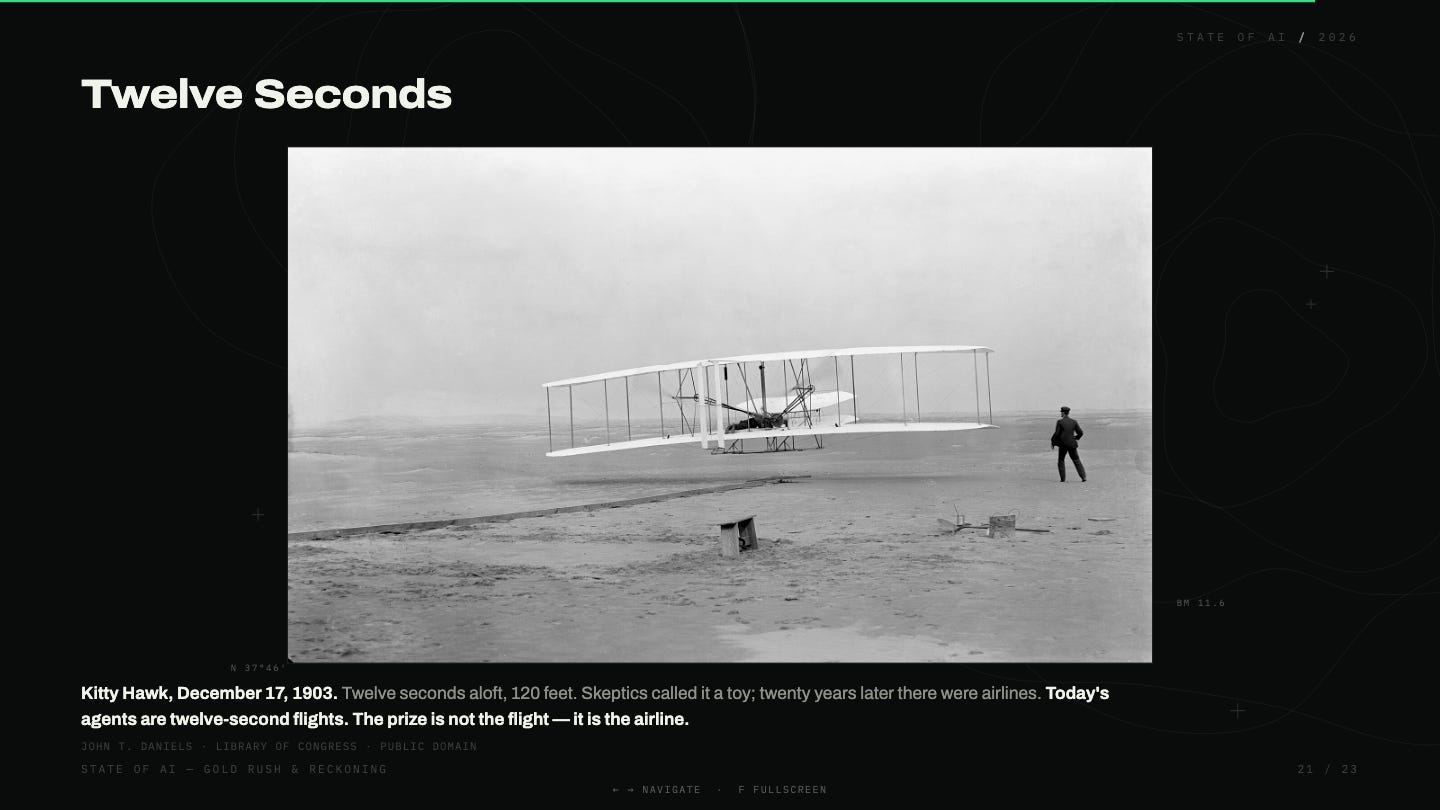
The first flight lasted twelve seconds and covered 120 feet. Witnesses called it a toy. Twenty years later there were airlines. That’s where agents are today — impressive, useful in spots, nowhere near the destination. The prize was never the flight. It’s the airline.
22. Sell work, not software — the $10T+ prize is the services market
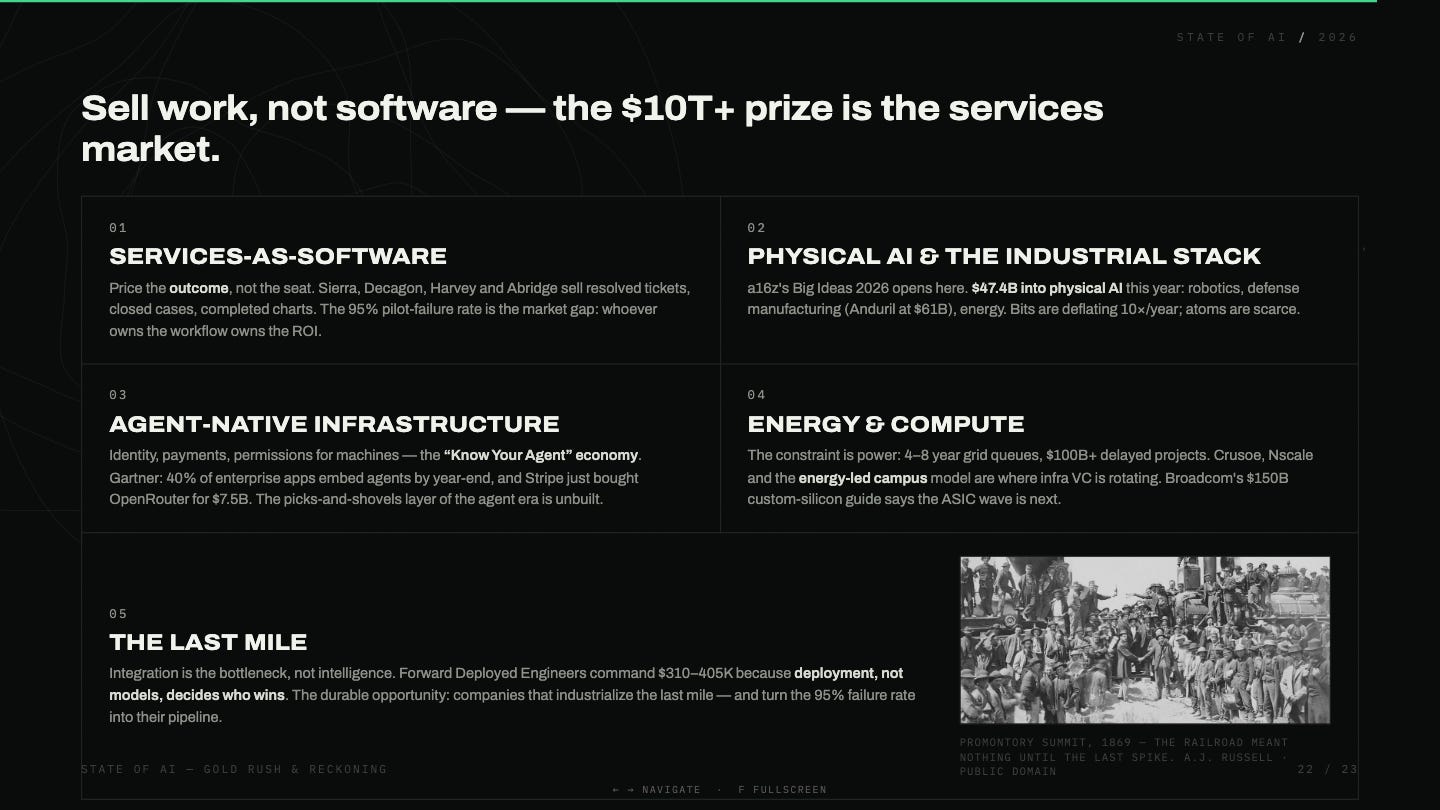
Sequoia and a16z published their 2026 theses and basically converged: services-as-software (sell outcomes, not seats), physical AI (bits deflate 10x a year; atoms are scarce), agent-native infrastructure (Stripe’s OpenRouter acquisition is the starting gun), energy and compute, and the last mile — whoever industrializes deployment turns the 95% failure rate into their pipeline.
23. The bottom line
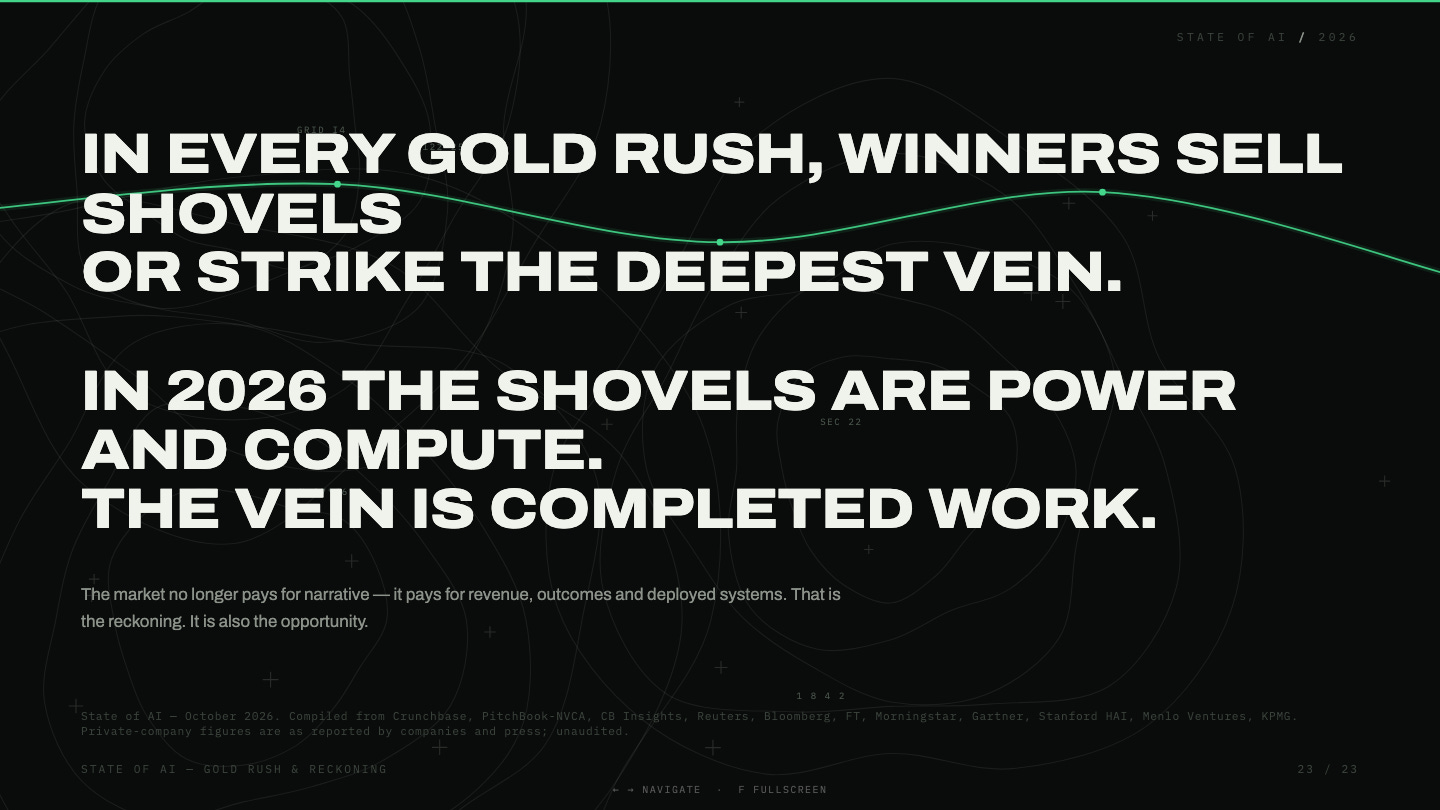
In every gold rush, the winners sell shovels or strike the deepest vein. In 2026 the shovels are power and compute; the vein is completed work. The market stopped paying for narrative this year — it pays for revenue, outcomes and deployed systems. That’s the reckoning. It’s also the biggest opportunity I’ve seen in my career.
Enjoyed this? The full deck is at here:— share it freely.
All data sourced on each slide; private-company figures are company-reported and flagged where self-reported.


