


And you, are pro open models or against it?
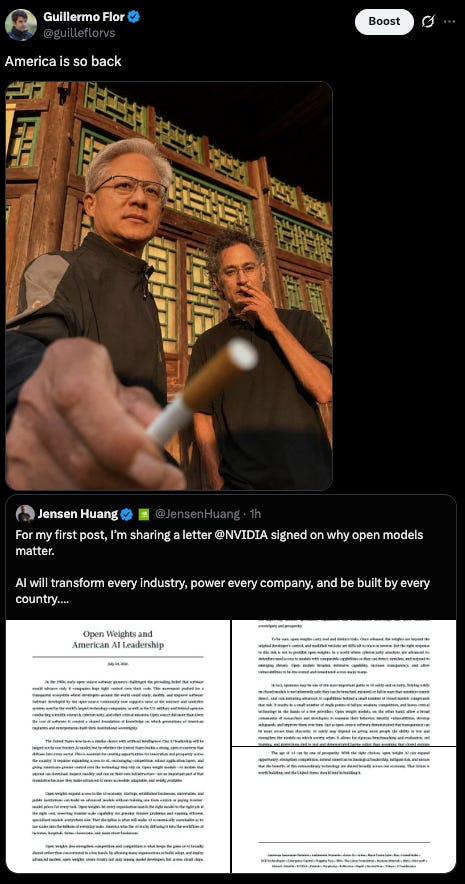
Almost 200 Silicon Valley companies, including Y Combinator and Proton, just told the Trump administration that banning Chinese open-weight models would make “hundreds of companies instantly die.” On the same day, 25 firms led by Nvidia, Microsoft, Meta, and Palantir sent their own letter warning against “premature restrictions,” while OpenAI and Anthropic, both gearing up for IPOs, pointedly refused to sign.
We read every letter, both op-eds, and the actual model releases from the past two weeks, then turned it all into a founder’s playbook for building a model layer that survives whatever Washington decides.
In this guide you’ll find:
Why 200 founders say a Chinese-model ban kills their companies overnight (and whether yours is exposed)
The cost-discipline playbook: how to match model to task so your unit economics survive at scale
Who signed, who refused, and what the OpenAI/Anthropic no-show tells you about the coming lock-in
The self-hosting escape hatch: building a model stack no policy shift can shut off
The 2026 open-weight shortlist: which models to build on right now
👋 Just a quick note before you continue!
If you are serious about building or investing in AI, you can subscribe here:
Here’s a good place to start:
↳Alex Karp’s Playbook for Which AI Companies Survive
↳19 great new details about Cursor’s rise
Try premium free for 7 days. Or get 50% off this week only.
1. Why 200 founders say a Chinese-model ban kills their companies overnight (and whether yours is exposed)
If your product runs any high-volume task on a downloadable Chinese model like Qwen or Moonshot because frontier API prices would wipe out your margin, a ban targets your unit economics directly. That is the specific mechanic behind the warning from Suhail Doshi, founder of AI infrastructure startup Particle, who told Business Insider on July 22 that “there’ll be hundreds of companies that instantly die” if Washington blocks downloads of Chinese open weights (businessinsider.com).
The letter came from the newly formed Little Tech Association, which sent its appeal to Trump, Commerce Secretary Howard Lutnick, and OSTP Director Michael Kratsios. It names the models at issue specifically, Moonshot AI and Alibaba’s Qwen, and targets the downloadable weights rather than API access. The founders’ core argument, in their own words: “American leadership requires two things: world-leading American open-weight models and continued access for U.S. builders to open models already available worldwide.” They asked for “targeted safeguards” instead of “broad prohibitions” (politico.com).
Their sharpest practical point is that a ban does not stop proliferation, it only handicaps the domestic side of it. The weights are already downloaded, mirrored, and running on servers worldwide. A U.S. prohibition removes them from the legal stack of American startups while leaving them freely available to everyone else, foreign competitors included.
Run the test on your own product this week. List every model call your app makes, tag each one by provider and by whether the task is high-volume or genuinely hard, and flag anything that would break at frontier pricing. If a Chinese open-weight model is carrying your cheap, high-frequency path, you are in the group Doshi is describing, and the next four sections are your contingency plan.
2. The cost-discipline playbook: how to match model to task so your unit economics survive at scale
Open weights are a survival issue because of cost discipline, not ideology. Microsoft laid out the exact principle in its July 24 essay: open weights “let every organization match the right model to the right job at the right cost, reserving frontier-scale capability for genuine frontier problems and running efficient, specialized models everywhere else.” Microsoft calls that discipline “what will make AI economically sustainable as its use scales into the billions of everyday tasks” (microsoft.com).
Google’s July release cadence is the clearest live demonstration of tiering. In three days it shipped three models at three price-performance points: Gemini 3.6 Flash for general quality work, 3.5 Flash-Lite explicitly “for scaling repetitive use cases like sorting tickets and extracting data,” and a locked-down 3.5 Flash Cyber restricted to governments. The Flash-Lite demo compared it head to head with 3.5 Flash on high-volume tasks:
The lesson: even a frontier lab does not run everything on its best model. It routes ticket-sorting and data extraction to the cheapest tier and reserves the expensive one for hard problems. If a $2T company enforces that discipline, a seed-stage startup burning $8 a call on frontier tokens for classification tasks has no excuse.
Build a routing layer this week: classify each request by difficulty, send the bulk of your volume to a cheap open-weight or Flash-Lite-class model, and reserve frontier calls for the small share of requests that genuinely need them. That single move turns a negative-margin AI feature into a positive-margin one, which is why the ban debate is really a margins debate.
3. Who signed, who refused, and what the OpenAI/Anthropic no-show tells you about the coming lock-in
The signatures tell you who wins under a ban and who loses. The 25-company letter against “premature restrictions” that would “stifle competition” was signed by the infrastructure and diffusion layer, Nvidia, Microsoft, Meta, and Palantir, and reported by CNBC on July 24 (cnbc.com). These companies make money when AI diffuses widely: more chips, more Azure seats, more open Llama downloads, more deployments.
OpenAI and Anthropic did not sign. CNBC notes both are “gearing up for potentially massive IPOs,” and that is the whole story. Closed frontier labs benefit when cheap open substitutes are removed from the legal market, because it pushes every high-volume task back onto their paid APIs. TechCrunch put it bluntly on July 20 in a piece titled “OpenAI is scared of open-weight models” (techcrunch.com). For them, a ban is not a safety measure, it is a moat.
The strongest signal of where the infra giants stand came from Jensen Huang’s first-ever post on X, where the Nvidia CEO shared the letter and argued that open models let organizations “inspect, modify and run AI locally while reducing dependence on foreign providers” (via Stocktwits and Digg). When a CEO breaks a lifetime of X silence for one issue, that issue is existential to his business.
The takeaway for founders: your incentives are aligned with the infra camp, not the frontier labs. Read any pricing or lock-in argument from a lab racing to IPO as self-interested, and design as if the closed labs will not protect your margins, because they have publicly declined to.
4. The self-hosting escape hatch: building a model stack no policy shift can shut off
The one architecture no policy shift can shut off is self-hosted open weights running on your own infrastructure. Once you have downloaded the weights and deployed them in your environment, no ban, price hike, or API deprecation reaches into your stack. Mistral built its enterprise pitch around exactly this, arguing on July 3 that the value from “data, workflows, feedback, and models” should accrue to the enterprise “rather than to model providers” (x.com).
On July 21, Mistral expanded its Microsoft partnership specifically to give “enterprises and regulated industries frontier AI they can control,” pairing open weights with the compute to run them (x.com). A self-hostable model is insurance against every scenario in this fight, including the ones nobody is predicting yet.
Mistral’s Robostral Navigate, released July 8, is the template for a specialized, self-hostable open model. This 8B robotics navigation model runs on a single ordinary RGB camera, hits 76.6% success on the R2R-CE unseen benchmark, and beats multi-camera systems by 9.7 points while using far less sensing. It is small enough to deploy anywhere and good enough to be state of the art at its job.
The concrete move: identify the one or two highest-volume tasks in your product, find an open-weight model in the 7B-to-30B range that handles them, and stand up a self-hosted deployment behind your routing layer as a fallback path, even if you keep hitting an API today. Hugging Face’s “Local AI 201” guide, posted July 21, is a starting point for the mechanics (x.com). If you can flip a config and route around any single provider, no letter to Trump can touch your business.
5. The 2026 open-weight shortlist: which models to build on right now
Build your default stack on models you can legally keep no matter what Washington decides, which means American and European open weights first, with Chinese models isolated behind a switch.
Mistral (French, self-hostable). The safest control-layer bet. Frontier-class enterprise models plus specialized releases like the 8B Robostral Navigate, all deployable in your own environment, backed by the expanded Microsoft compute partnership announced July 21. Use it for anything where control and data residency matter (x.com).
Meta Llama (American, open). The reference open-weight family from a company that signed the anti-restriction letter, which means a strong incentive to keep releasing weights. The default for general-purpose self-hosted workloads that need broad ecosystem support and tooling.
Google Gemini variants (American, tiered API). Not open weights, but the cleanest cost-tiering options: 3.6 Flash for quality, 3.5 Flash-Lite for repetitive high-volume tasks like ticket sorting and data extraction, and 3.5 Flash Cyber restricted to governments. Use these to fill the price-performance tiers your self-hosted stack does not cover (x.com).
Moonshot AI and Alibaba Qwen (Chinese, at risk). The exact models named in the ban debate. They frequently offer the best price-to-performance available, which is why founders depend on them and precisely why they are the legal risk. If you use them, isolate them behind your routing layer so a single config change swaps in a Llama or Mistral equivalent the day a rule lands. The New York Times argued on July 23 that these Chinese open weights are the underlying strength of China’s AI strategy and that “America should take cues” (nytimes.com); treat them as valuable but expendable in your architecture.
Structure the whole stack so no single model is load-bearing: an American or European open-weight default, a tiered API layer for cost, and any Chinese model quarantined behind a switch. Do that, and whatever Washington decides in the coming weeks becomes a config change instead of an extinction event.
And you, are pro open models or against it?