


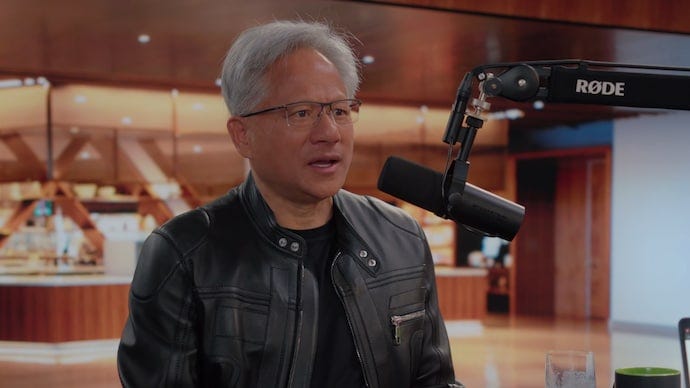
Hey everybody, Jensen Huang just did another interview with Dwarkesh Patel and it was great.
So I thought it could be very valuable to break it down for you.
💭 Remember!
As a AI Opportunity + PMF subscriber you’ll also get access to all the other Claude resources we put together, such as:

4️⃣ 🚨 The Ultimate AI Fundraising Copilot (Built With Claude)
1️⃣2️⃣ How I Rebuilt My SEO Strategy Inside Claude (The Playbook)
We’re already 70,000+ founders and operators inside!
and just for this week you can get AI + PMF at 30% Discount!
Inside you will find:
Why Jensen thinks Nvidia’s real moat is much bigger than GPUs
Why he believes AI will increase software usage, not destroy it
Why supply chain coordination is one of Nvidia’s biggest strategic advantages
Why he still thinks GPUs beat TPUs and custom ASICs
Why he sees China as an ecosystem battle, not just an export control debate
1. Nvidia’s real business: turning electrons into tokens
The best line in the interview was also the simplest:
The input is electrons. The output is tokens. In the middle is Nvidia.
That is probably the cleanest way to understand the company.
Nvidia is not just trying to build the best chip.
It is trying to build the best system for transforming energy into useful AI output.
That includes:
silicon
packaging
networking
interconnects
software
libraries
optimization
algorithms
and the ecosystem around all of it
This is why Jensen pushes back so hard on the idea that Nvidia could get “commoditized” just because parts of the stack are outsourced or because software is becoming easier to generate.
His point is simple:
the hard thing is not writing code
the hard thing is making the whole stack work together at extreme scale.
That is where Nvidia lives.
And that is why he does not think the company is becoming a commodity.
2. The moat is not the chip. The moat is the system.
A lot of people still talk about Nvidia as if its advantage is mostly having the fastest GPU.
That is too narrow.
Jensen’s argument is that Nvidia’s moat has four layers.
A. CUDA
CUDA is still the center of gravity.
Not because customers cannot write their own kernels.
They can.
But because CUDA gives developers the richest base layer to build on:
the deepest tooling
the most mature libraries
the broadest compatibility
the largest install base
That matters more than raw benchmark slides.
If you are building an AI company, you want your software to run everywhere. Nvidia gives you that.
B. Install base
Jensen repeatedly comes back to this.
Nvidia is everywhere:
all major clouds
enterprise data centers
startups
research labs
robotics
edge systems
That means software built on Nvidia has immediate distribution.
That is an underrated advantage.
C. Full-stack co-design
Nvidia is not just making chips in isolation.
It can change:
the processor
the fabric
the network
the system design
the libraries
the kernel layer
and sometimes even the algorithmic implementation
That is a different game from building a narrow accelerator.
D. Supply-chain orchestration
This may be the least appreciated part of Nvidia’s moat.
Jensen makes it clear that Nvidia’s strength is not just invention.
It is coordination.
The company can align upstream suppliers, downstream buyers, packaging partners, memory providers, foundries, OEMs, clouds, and application builders around a future that it sees earlier than most of the market.
That is not a normal chip-company capability.
That is industrial power.
So the real takeaway is this:
Nvidia’s moat is not one thing. It is compute architecture + software + distribution + supply chain + ecosystem.
That is why it is so hard to dislodge.
3. Jensen’s contrarian view: AI may make software companies bigger
This was one of the most important parts of the conversation.
The current market narrative says AI will commoditize software.
Jensen’s view is almost the opposite.
He thinks AI will cause tool usage to explode.
Why?
Because the number of software users is about to stop being limited by the number of humans.
In the old world:
one engineer used one set of tools
one analyst used one stack
one designer used one interface
In the new world:
each person may have multiple agents
each agent may use multiple tools
each workflow may generate far more tool interactions than before
That means the number of software “users” could increase massively, even if many of those users are agents rather than people.
He gave examples like:
EDA tools
design compilers
floor planners
engineering systems
His point is that companies are not going to use fewer tools.
They may end up using far more of them, because agents will become tool users too.
This is a very important idea.
If Jensen is right, AI does not simply compress software spend.
It changes the unit of demand.
From human seat count to human + agent output.
That could be one of the biggest shifts in software over the next few years.
4. Why Nvidia keeps scaling while others get stuck
Another core message from the interview:
Nvidia’s advantage is not just that demand is high.
It is that the company has learned how to prepare the system around that demand.
Jensen describes a world where Nvidia is constantly:
forecasting demand years ahead
identifying future bottlenecks
informing suppliers before the bottleneck hits
getting them to invest early
helping shape the ecosystem so capacity is there when needed
That is how you get from “everyone is bottlenecked” to “we are still shipping at scale.”
He mentions this directly across:
CoWoS
HBM
photonics
logic capacity
packaging
testing workflows
and even basic labor constraints like electricians and plumbers
His broader point is:
most bottlenecks are not permanent
they are usually 2 to 3 year problems if the demand signal is strong enough and someone coordinates the response.
That is a very bullish view on compute scaling.
But he does highlight one bottleneck he takes more seriously than chips:
5. Energy is the real bottleneck
Jensen sounds relatively calm about semis bottlenecks.
He does not sound calm about energy.
That came through clearly.
You cannot build:
AI factories
reindustrialization
robotics
EV production
advanced manufacturing
new data centers
without energy.
His message is that America can solve packaging, memory, and foundry bottlenecks faster than it can solve energy bottlenecks.
That matters because it shifts the real strategic question.
The future of AI infrastructure may depend less on who can tape out the next chip, and more on who can secure the power to run it.
That is a much bigger systems question.
6. Why he still thinks GPUs beat TPUs and ASICs
This was the most technical part of the interview, but the core argument was clear.
Jensen does not deny that TPUs and ASICs can be strong for specific workloads.
What he denies is that the future of AI is stable enough for narrow specialization to dominate.
His reasoning:
AI is not just one repeated matrix multiply forever.
The field keeps changing through:
new attention mechanisms
new architectures
new routing methods
new parallelization patterns
new model designs
new inference patterns
new system-level tradeoffs
In that world, programmability wins.
That is the heart of the Nvidia case.
Jensen’s claim is that most of the big leaps in AI performance do not come from pure semiconductor scaling.
They come from co-design across the stack.
That is how Nvidia got the kind of gains he references from Hopper to Blackwell.
Not from Moore’s Law alone.
But from:
numerics
system architecture
software
model design
distribution of workloads
network and fabric improvements
and deep optimization at every level
That is why he keeps returning to CUDA.
Not because CUDA is some magical piece of software.
But because it is the programmable layer that lets Nvidia adapt as AI changes.
That is the strategic point.
ASICs can be good at a frozen problem. Nvidia is betting AI will not stay frozen long enough.
7. Nvidia’s strategy is to do only what nobody else will do
Jensen repeats one idea again and again:
do as much as needed, as little as possible
This is one of the cleanest explanations of Nvidia’s strategy I’ve heard.
It explains why Nvidia:
builds core platform layers
supports neoclouds instead of becoming one
invests in ecosystem players
helps labs scale
but avoids absorbing every adjacent business
His test seems to be:
If Nvidia does not do this, will it happen anyway?
If the answer is no, Nvidia steps in.
If the answer is yes, Nvidia prefers to partner.
That is why it built CUDA and NVLink.
That is why it helps enable CoreWeave, Crusoe, and others.
That is why it invests in model companies.
But it is also why it does not want to become the entire stack.
This is not empire building for its own sake.
It is selective control around the hardest irreplaceable layers.
That discipline is part of why Nvidia has stayed so coherent while expanding so aggressively.
8. China: Jensen’s real fear is ecosystem loss
Jensen Huang's argument on China chip bans is sharper than most people realize:
Banning Nvidia from selling to China doesn't stop China from building AI. It stops the US from being the supplier.
China already has Huawei. They're building their own stack regardless. The ban doesn't remove Chinese AI capability — it removes American leverage over it.
Every dollar Nvidia doesn't earn in China is R&D that doesn't get funded, while Huawei captures that same revenue and reinvests it domestically.
The national security argument for the ban assumes a world where China can't build chips without us. That world ended years ago.
Now the US is in the worst possible position: funding China's semiconductor independence while defunding its own.
The China section was the most heated, but Jensen’s underlying point was consistent.
He thinks many people frame the issue too narrowly.
The standard debate is:
Should America sell advanced compute into China or not?
Jensen’s framing is different:
What happens if America forces the world’s second largest market to build around a non-American stack?
That is the part he keeps coming back to.
His concern is not only short-term revenue.
It is long-term ecosystem drift.
He believes that if Nvidia is pushed out:
Chinese developers optimize elsewhere
open-source models may optimize elsewhere
the global software ecosystem may tilt elsewhere
and America weakens one of the most important layers of its own AI stack
You can disagree with him on policy.
But the strategic logic is important.
He is not defending China sales only as transactions.
He is defending them as a way of keeping the global AI ecosystem anchored to the American compute stack.
That is a much bigger argument than “we want to sell more chips.”
It is really an argument about platform control.
9. The hidden worldview behind the interview
Step back from the specific topics and you can see Jensen’s broader worldview.
He believes:
AI is an industrial revolution, not just a software cycle
the winners will be the ones that build systems, not features
software usage will rise because agents will become users
supply chains are strategic weapons
energy matters more than most people realize
programmability matters more than narrow optimization
ecosystems matter more than products
and America should lead by scaling, not by retreating
This is why Nvidia feels less like a chip company every quarter.
And more like the operating layer for the AI economy.
Hope this was valuable!
Cheers,
Guillermo