


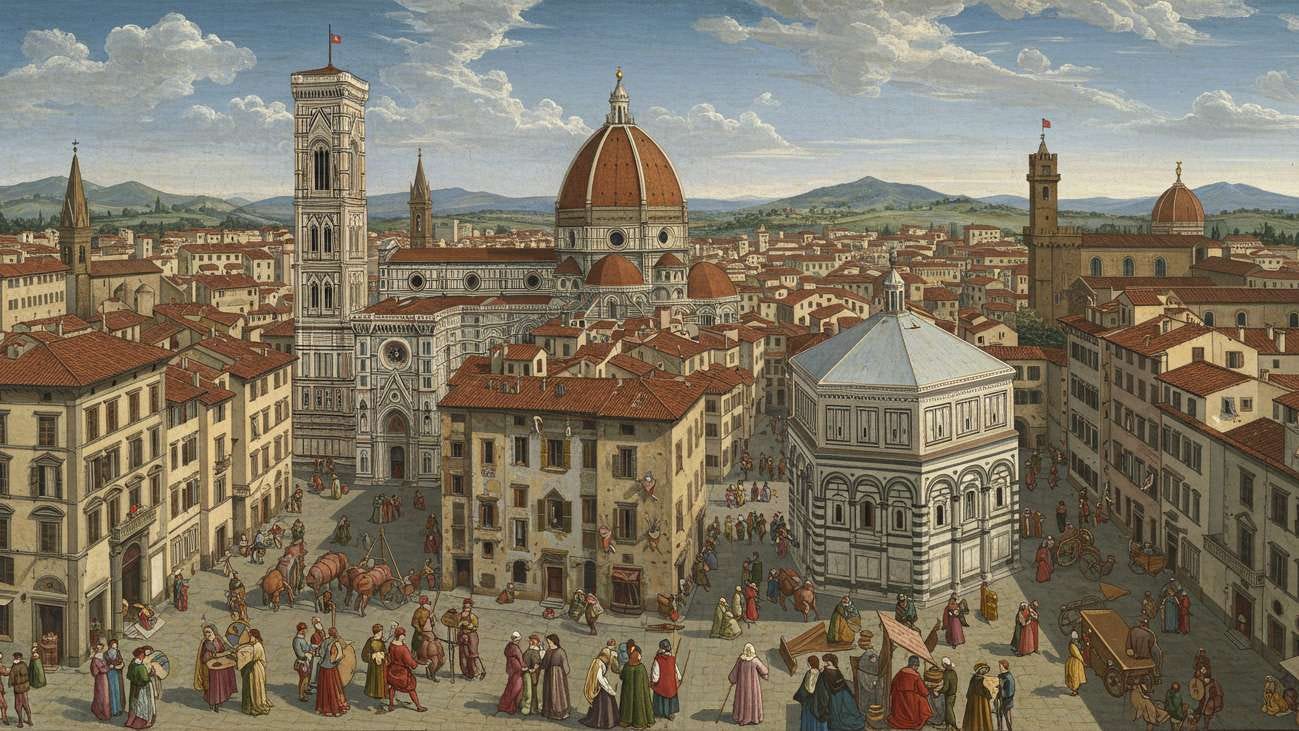
The Renaissance was a period of major cultural, artistic, scientific, and intellectual growth in Europe that lasted roughly from the 14th century to the 17th century.
The word Renaissance means “rebirth” in French because it marked a renewed interest in the ideas, art, and learning of ancient Greece and Rome.
What where the main ideas of the reinassance?
Humanism:
people should study human achievements, reason, and potential, not just religion.Individualism:
individuals could achieve greatness through their talents and efforts.Classical Learning:
admiration for and study of ancient Greek and Roman ideas.Curiosity and Inquiry:
questioning old beliefs and exploring science, nature, and the world.Realism in Art:
portraying people and nature as they actually appear.
What technological development pushed the Reinassance?
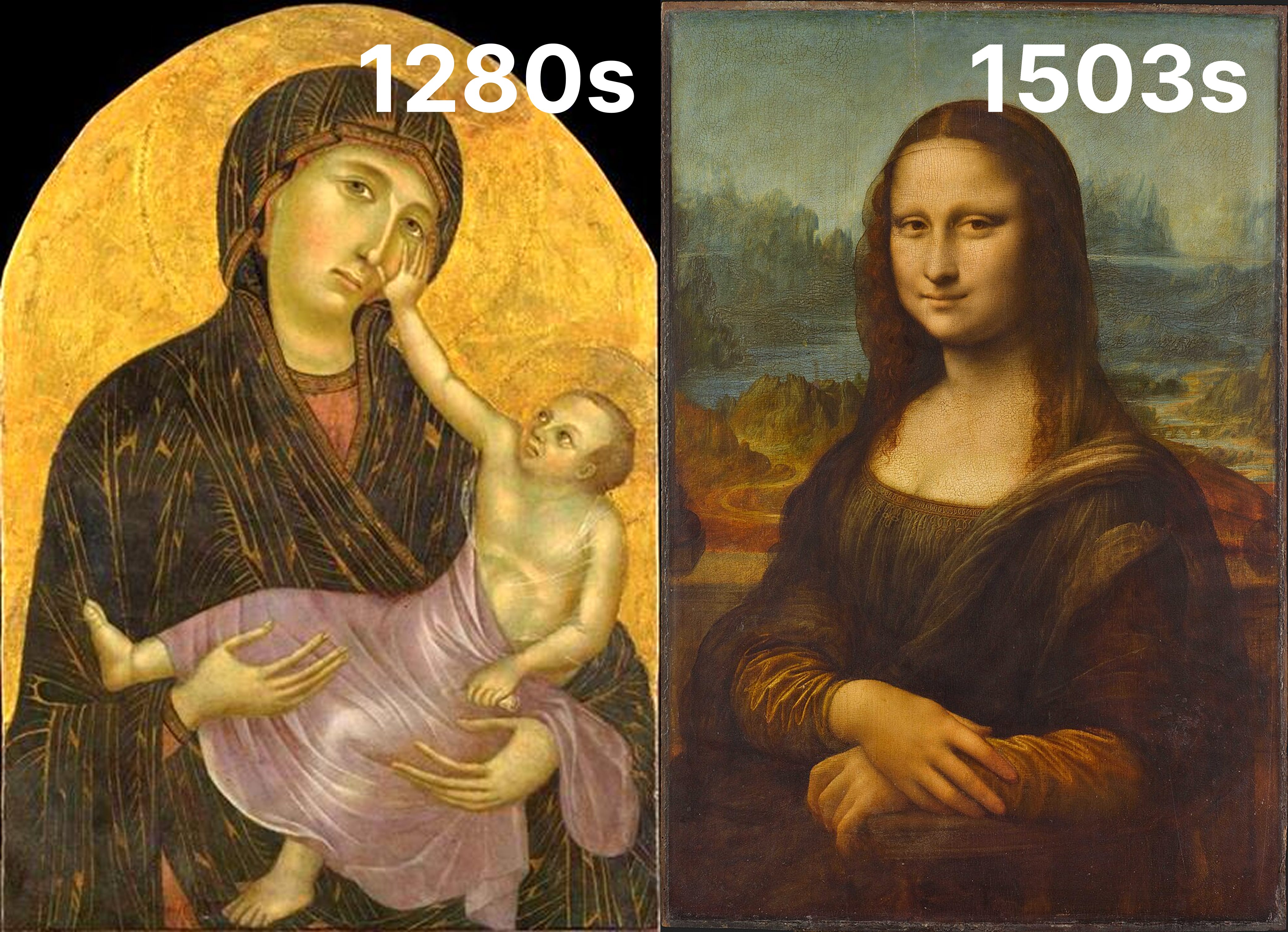
The key technological development was the printing press (invented by Gutenberg around 1440), which helped spread Renaissance ideas quickly across Europe. Before that, books had to be copied by hand, making knowledge expensive and rare.
Before the printing press, knowledge was scarce, expensive, and controlled by a small elite.
The printing press dramatically reduced the cost of accessing and spreading knowledge.
This accelerated learning, science, innovation, and eventually transformed society.
Similarly:
Before AI, creating knowledge-based work (writing, coding, research, design, analysis) required significant human expertise and time.
AI dramatically reduces the cost of producing and applying knowledge.
This could accelerate innovation, education, scientific discovery, and economic productivity across society.
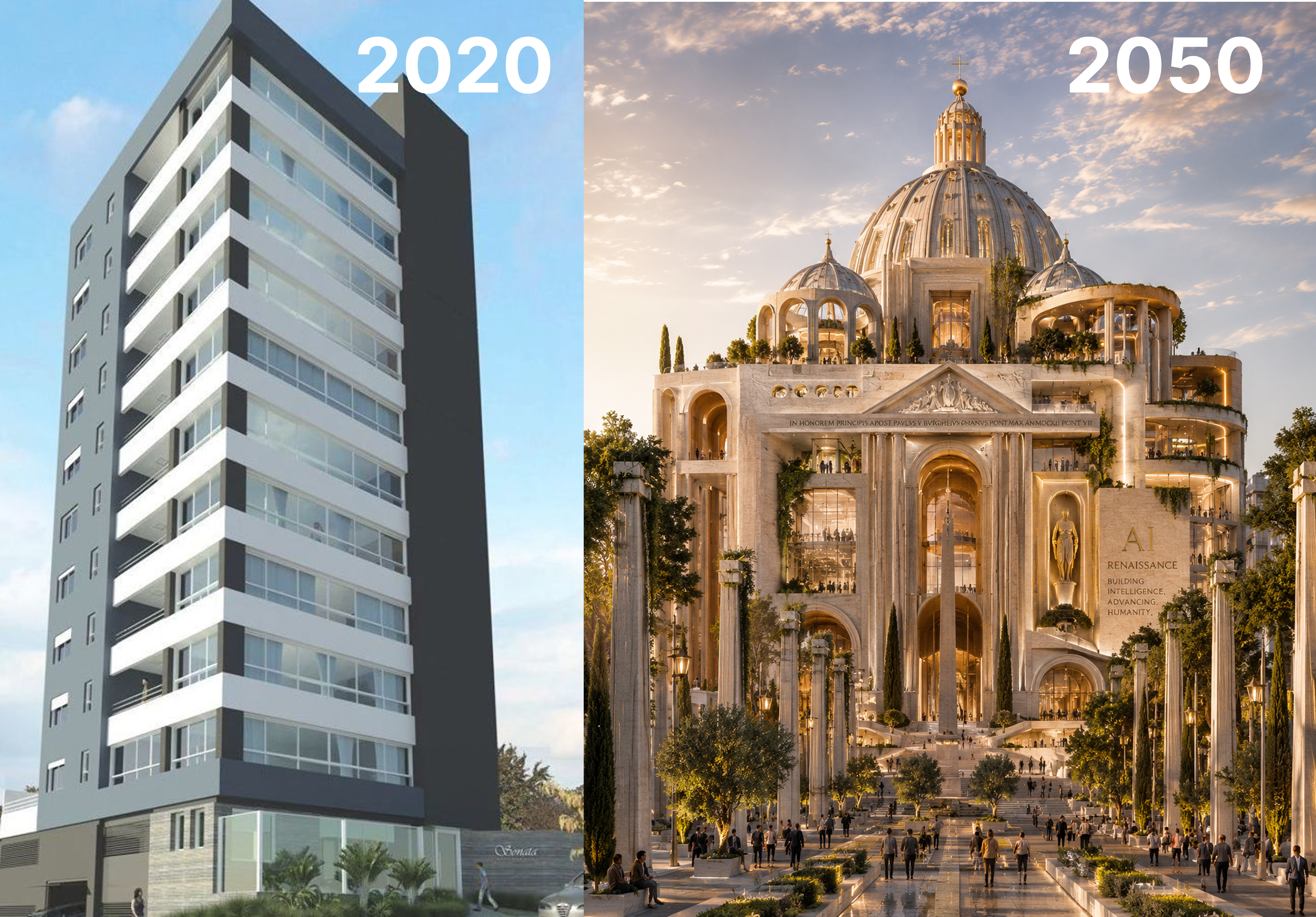
If the printing press democratized access to knowledge, AI democratizes the ability to create and use knowledge.
The Renaissance directly transformed these major fields:
Art – painting, sculpture, architecture
Literature – poetry, drama, prose, vernacular writing
Education – curriculum, universities, classical studies
Philosophy – humanism, ethics, political thought
Science – observation, experimentation, astronomy, anatomy
Mathematics – geometry, perspective, practical applications
Medicine – anatomy, surgery, medical research
Technology & Engineering – mechanics, military engineering, inventions
Printing & Publishing – mass dissemination of knowledge
Religion – biblical scholarship, challenges to Church authority, groundwork for the Reformation
Politics – statecraft, diplomacy, political theory (e.g., Machiavelli)
Economics & Commerce – banking, accounting, trade networks
Geography & Exploration – navigation, cartography, overseas exploration
History – critical study of historical sources
Music – new forms of composition and notation
Law – renewed study of Roman law and legal scholarship
Linguistics & Languages – study of Greek, Latin, and vernacular languages
The role of apprenticeship workshops in the Renaissance is massively underrated. They were essentially the AI labs, startups, and universities of their time—all combined into one.
What was a workshop?
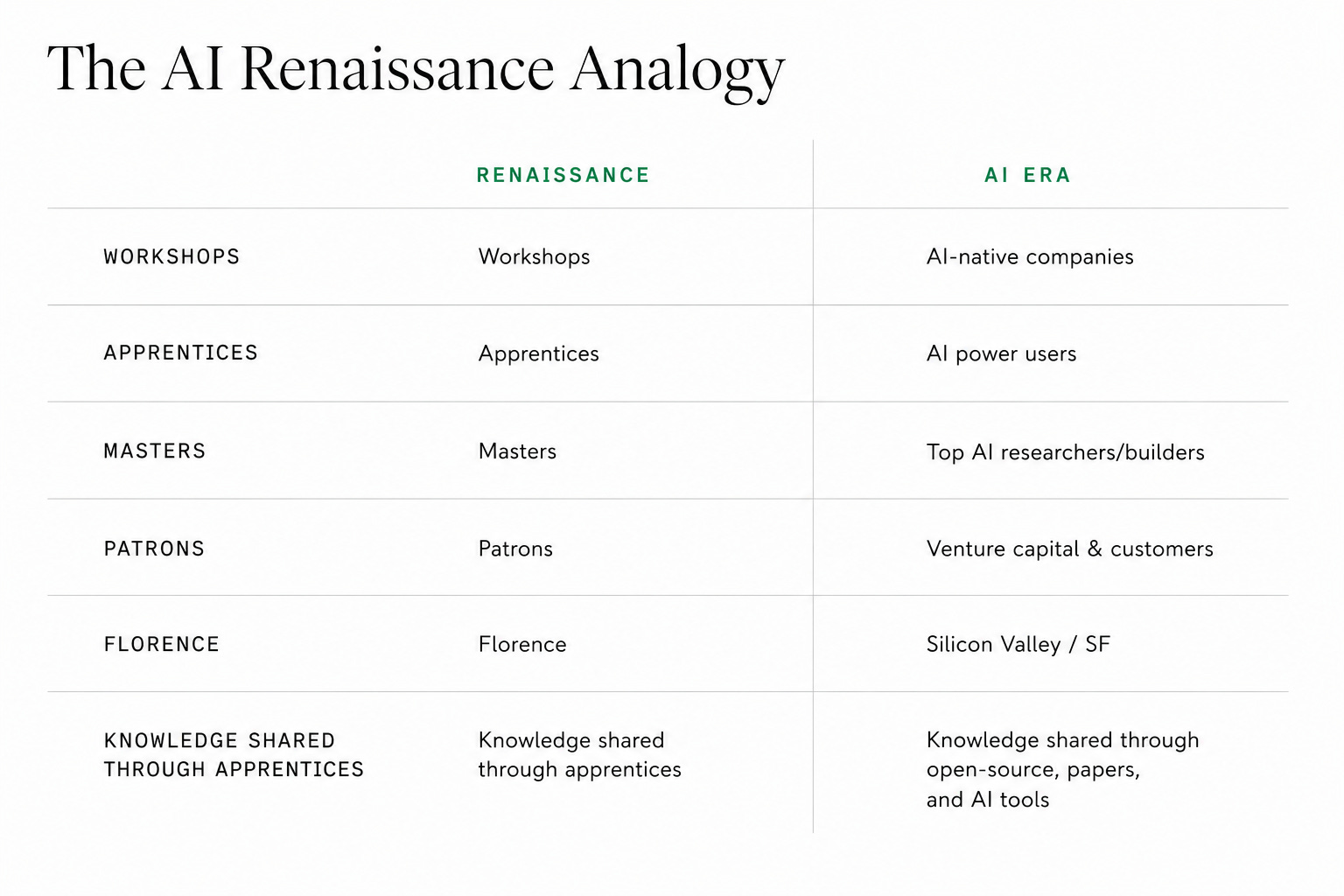
A workshop (bottega in Italy) was run by a master like Verrocchio, Ghirlandaio, or Bellini.
Inside you had:
Apprentices (young learners)
Journeymen (experienced workers)
Masters (elite creators)
Patrons (customers funding projects)
They worked together on real commissions every day.
Why did they accelerate the Renaissance?
1. They compressed learning
Before workshops, knowledge was often scattered.
A 12-year-old apprentice could learn:
Drawing
Anatomy
Geometry
Engineering
Sculpture
Business
all in the same place.
Leonardo da Vinci entered Verrocchio’s workshop around age 14 and absorbed multiple disciplines simultaneously.
2. They enabled knowledge transfer
Every generation built on the previous one.
Think:
Master
  ↓
Senior apprentice
  ↓
Junior apprentice
  ↓
Next generation master
Ideas didn’t disappear when someone died.
3. They created talent density
Florence had dozens of elite workshops within walking distance.
The best people constantly interacted.
This is similar to:
Silicon Valley
OpenAI + Anthropic + DeepMind
Y Combinator
Talent clustered geographically.
4. They mixed disciplines
A Renaissance workshop wasn’t just art.
A workshop might work on:
Architecture
Sculpture
Engineering
Military devices
Stage design
Painting
This cross-pollination generated new ideas.
Leonardo is the perfect example:
Artist
Anatomist
Engineer
Inventor
because workshops encouraged interdisciplinary thinking.
5. They created competition
Masters competed for prestige and commissions.
When one innovated:
Better perspective
Better anatomy
Better engineering
everyone else had to improve.
Innovation spread rapidly.
Now, who’s building the Florence of the AI reinassance?
Cheers,
Guillermo