


Hey everybody, welcome back!
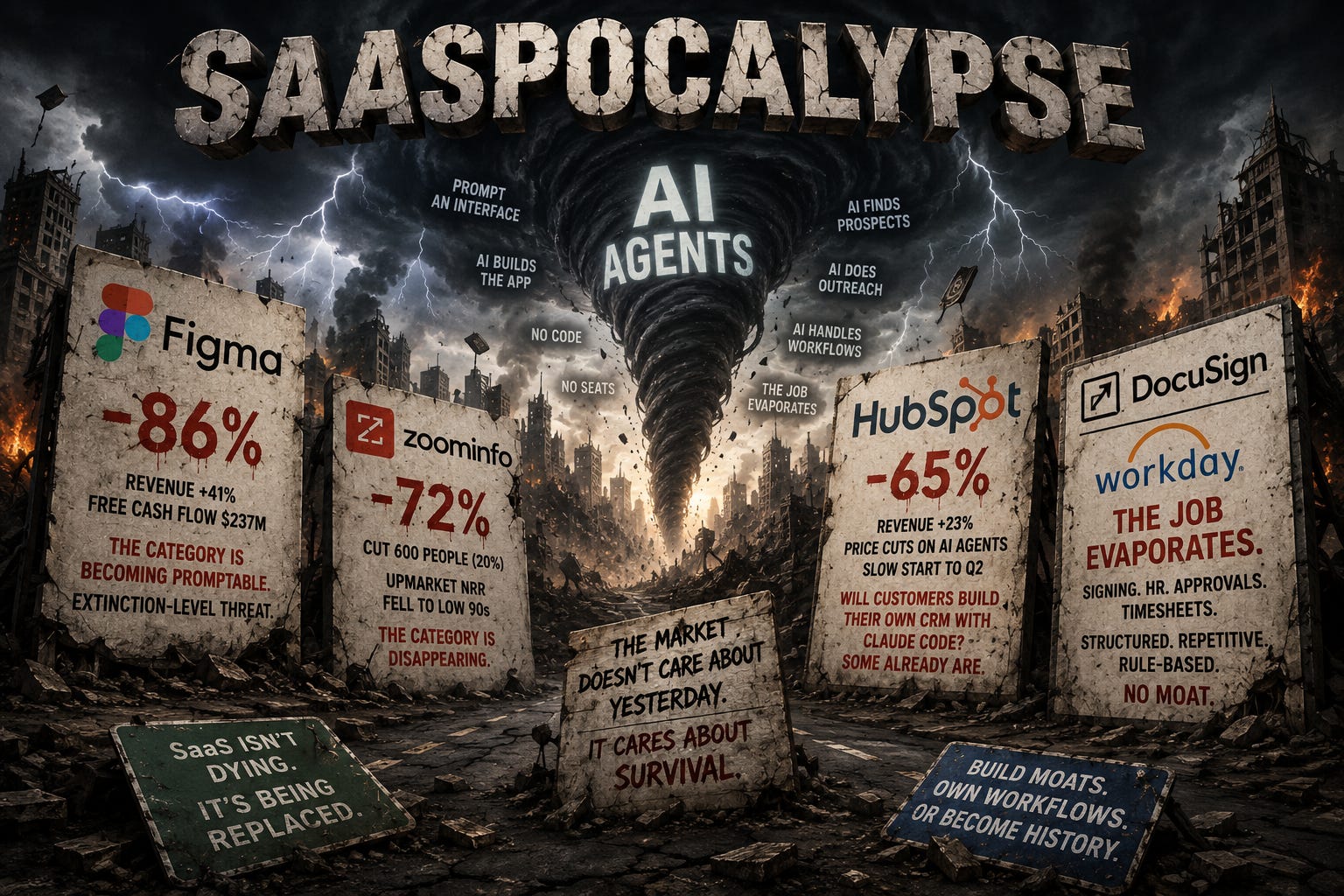
On February 3rd, 2026, a Jefferies trader coined a new word. In 48 hours, $285 billion in market cap vanished from software stocks. He called it the “SaaSpocalypse.”
By April, the total damage had hit $2 trillion. The iShares Software ETF had fallen 35% from its September 2025 peak. The Nasdaq, in the same period, was up 18%.
This wasn’t a recession nor a rate hike. It was a product launch.
Let’s go through exactly what happened, who got destroyed and why, who survived and why, and what the actual opportunity looks like for founders and investors from here.
In this newsletter:
TABLE OF CONTENTS 🔥
PART I: The SaaSpocalypse
How hundreds of billions of dollars were wiped from software stocks and why investors suddenly started questioning the future of SaaS.
PART II: The Moment Everything Changed
Claude Code, AI agents, and the realization that software might no longer be the final destination for getting work done.
PART III: The Great Unbundling
Why founders are replacing software with prompts, agents, and custom-built internal tools—and which SaaS categories are most at risk.
PART IV: The Winners and Losers
The companies caught in the blast radius, the businesses AI is making stronger, and the ones investors are most worried about.
PART V: The Next $100B Software Companies
Why the biggest opportunities won’t come from building another SaaS tool, but from building software designed for a world where AI does the work.
What happened
For two decades, SaaS ran on one assumption: software sells to humans. You hire 100 people, you need 100 seats. Revenue scales with headcount, and headcount only goes up.
On February 3rd and 4th, Anthropic released Claude Cowork, a suite of autonomous agents capable of managing complex, multi-step business processes like lead generation and legal auditing entirely without human intervention. OpenAI followed with Project Operator, an intelligence overlay letting AI navigate any software interface as if it were a human user.
The implication was immediate: if AI agents do the work of your employees, you don’t need seats for those employees. Wall Street didn’t wait for proof. It repriced the entire sector in two days.
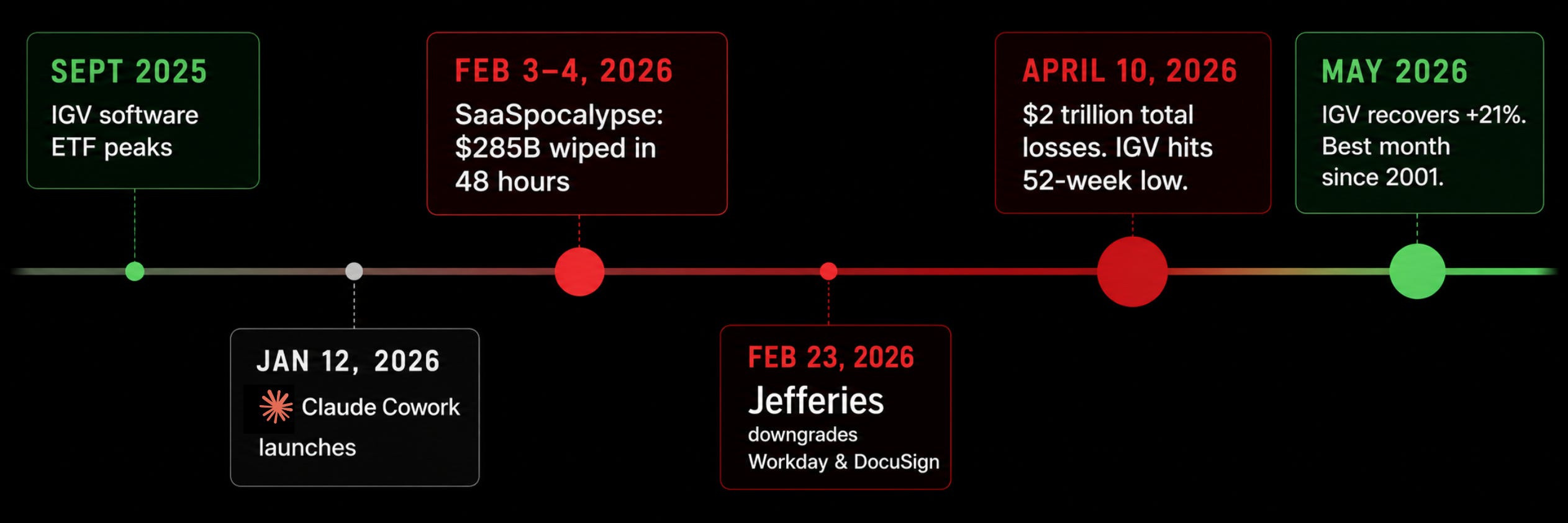
The selloff wasn’t a correction. It was a reclassification. Investors looked at the speed of agentic AI progress and concluded that hundreds of SaaS companies built on per-seat pricing were structurally overvalued. If an AI agent can do the work of 10 humans, why would any company pay for 10 seats?
The damage
Why the losers are losing
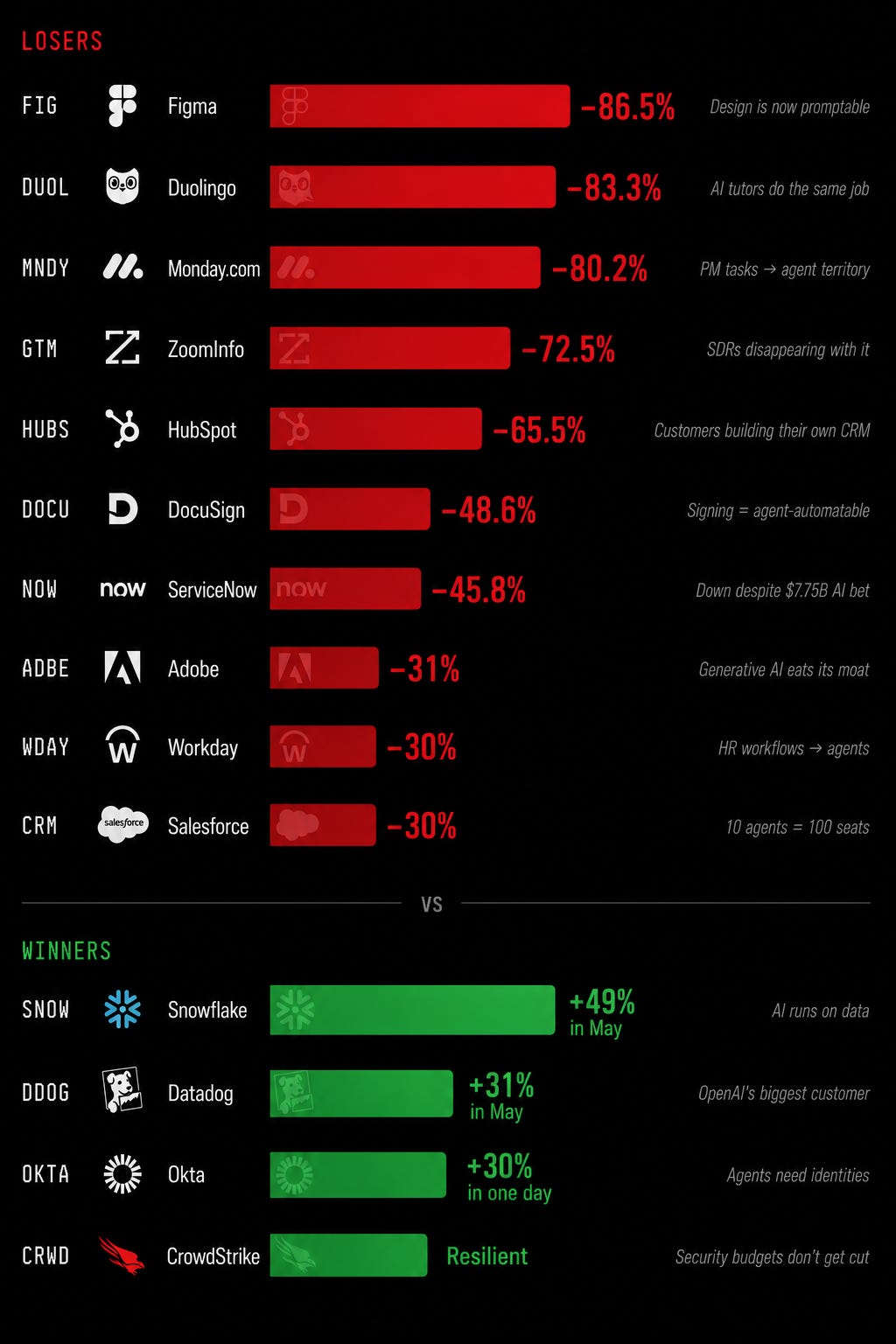
Every company on the red side shares the same problem, just expressed differently.
Figma:
Figma (−86%) still grew revenue 41% last year. Still generates $237M in free cash flow. Still lost 86% of its stock price. The market isn’t looking at the past, it’s looking at whether Figma’s core product survives a world where you can prompt a full app interface into existence in an afternoon. The category is becoming promptable. That’s an extinction-level threat to a tool that sells seats to designers.