



Y Combinator just published its requests for Spring 2026 and, among all the things you can find in there, there’s one idea that’s very easy to skim past if you’re not paying attention: AI-native agencies.
At first glance it sounds familiar: every agency already claims to use AI, everything is “AI-powered,” so it’s tempting to dismiss this as just another variation of the same trend.
But that’s not really what YC is pointing at.
If you read it more carefully, what’s emerging is a deeper shift:
the next wave of meaningful AI companies might not start by selling software, but by actually doing the work.
That connects directly to what we saw in the Sequoia piece I wrote (read it here) and that YC is confirming: the next trillion company might be an services company, not software.
So I decided to follow my research into this and see why:
YC’s AI Native Agencies Thesis
Why to start an AI Native Agency
The Difference Between AI in Agencies vs AI-Native Agencies
Which Agency Categories Will Be Disrupted First by AI (And Why These Ones Win)
Top 15 AI Startups Moving Toward the Agency Model

1. YC’s AI Native Agencies Thesis
For the past decade, the dominant playbook was clear and almost unquestioned: build software and sell it to agencies or service providers.
Agencies were seen as:
inefficient
messy
hard to scale
YC is now suggesting something that moves in the opposite direction.
What if, instead of building tools for agencies, you build the agency itself but redesigned from the ground up?
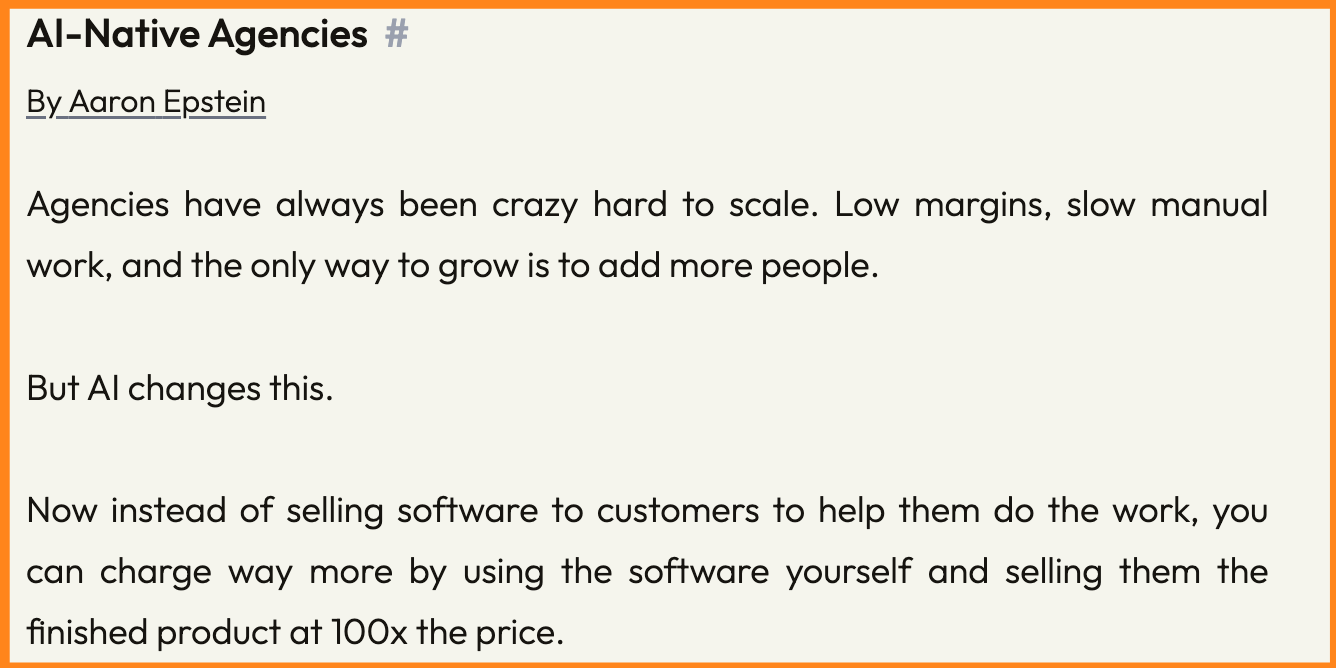
At the same time, the real shift is in the economics.
Historically, agencies scaled linearly:
more clients → more people → thinner margins → more complexity → inconsistent quality.
With AI, that relationship breaks. You can:
increase output per person
reduce the marginal cost of delivery
standardize parts of quality that used to be unpredictable
But the most important part is this: you can still sell the same outcomes at high prices while your internal cost structure changes dramatically.
That’s where the real advantage comes from:
not doing things better, but doing them on a completely different economic base.
From here on, this is for paid subscribers only.
If you want to keep reading, you can subscribe here:
