


Sequoia recently told the market that the next trillion-dollar AI companies will sell work, not software. Instead of charging for software seats, they will complete the work itself and capture a share of the much larger global labor budget.
A few weeks ago, I broke down why that thesis is so compelling.


Then Andrew Côté published a rebuttal that exposes the uncomfortable weakness inside it:
“Using AI for a task trains AI to do that task, so every services niche eventually becomes a niche the model owns outright.”
That is not always technically literal. Enterprise providers may not train on customer data, companies may self-host models, and proprietary workflows do not automatically flow back to foundation-model labs.
But economically, the direction is the same: as foundation models improve, more of the value created by thin AI service layers becomes commoditized.
That breaks the simplest version of Sequoia’s thesis.
So where does the durable value go?
I pulled apart both theses to map where the money may actually go next, including physical markets where a single industrial process can represent hundreds of billions of dollars in annual activity.
In this issue you’ll find:
Why “sell work, not software” may train its own killer
Software investing is close to over
The five enormous atoms markets Côté is pointing toward
How AI and robotics could bring software-like leverage to physical industries
Who is already building the atoms version of this thesis
What founders and investors should start, back or partner with before this becomes consensus
Powerful models are only as useful as the company context they can access!
Make enterprise AI actually work with Glean, the context layer that connects every model, tool and workflow.
Glean connects your organization’s knowledge, people, permissions and activity to give AI the understanding it needs to deliver relevant, secure and work-ready results.
With one governed context and intelligence layer across tools like Claude, Cursor, Copilot, and custom agents, Glean helps your company:
Give AI the right context: connect knowledge across 275+ enterprise applications while preserving permissions, metadata and access controls
Get more value from every model: improve retrieval, reduce unnecessary tool calls and use approximately 30% fewer tokens than off-the-shelf MCP tools.
Stay flexible as AI evolves: access 35+ models (including Claude, GPT and Gemini) without rebuilding your context layer or locking your company into one provider
1. Why “sell work, not software” trains its own killer
The flaw in Sequoia’s “sell work, not software” thesis is captured in Côté’s line:
“Using AI for something trains it to do that task.”
Again, this should be understood as an economic principle, not always as a literal description of model training.
A customer interaction does not necessarily become a training example sent directly to OpenAI, Anthropic or Google. But every successful AI workflow reveals what can be automated, which tools are required, where humans intervene and what a correct output looks like.
That knowledge spreads.
Model providers improve their reasoning and tool use. Competitors replicate the workflow. Open-source models catch up. Customers learn to perform more of the process themselves. What was once a differentiated service gradually becomes a native model capability or a standard feature.
Côté’s conclusion is that “every possible niche where you can use AI to do something better eventually becomes a niche occupied by AI.”
That does not mean every AI services company disappears. It means the service itself is not automatically the moat.
An AI services business that wraps a foundation model and sells its output may initially capture attractive margins. But its advantage often comes from a temporary gap between what the customer can do directly and what the company can orchestrate on the customer’s behalf.
That gap closes on the model’s schedule, not the startup’s.
Sequoia’s own feed illustrates the direction. Promoting Factory AI’s Matan, the firm wrote that almost every token today begins with a human asking a model to do something, but that within 12 to 24 months, 90% of tokens could be machine-initiated.
That human typing “hey, go do this” is precisely the human-in-the-loop signal that teaches the model to remove the human. Sequoia frames the shift from human-initiated to machine-initiated tokens as the bull case for AI labor. Read it Côté’s way and it is the countdown clock on every services wrapper: the closer we get to 90% machine-initiated, the less any middle layer between customer and model gets to keep.
So run this test before you build or back an AI services company: what remains defensible after the foundation model has ingested a year of your usage? If the answer is “our workflow,” “our prompts,” or “our fine-tune,” you are selling the training data for your own obsolescence. If the answer is a proprietary distribution channel, a regulated license, or a physical asset the model cannot replicate, you have a real business. Most services plays fail that test.
2. Software investing is close to over
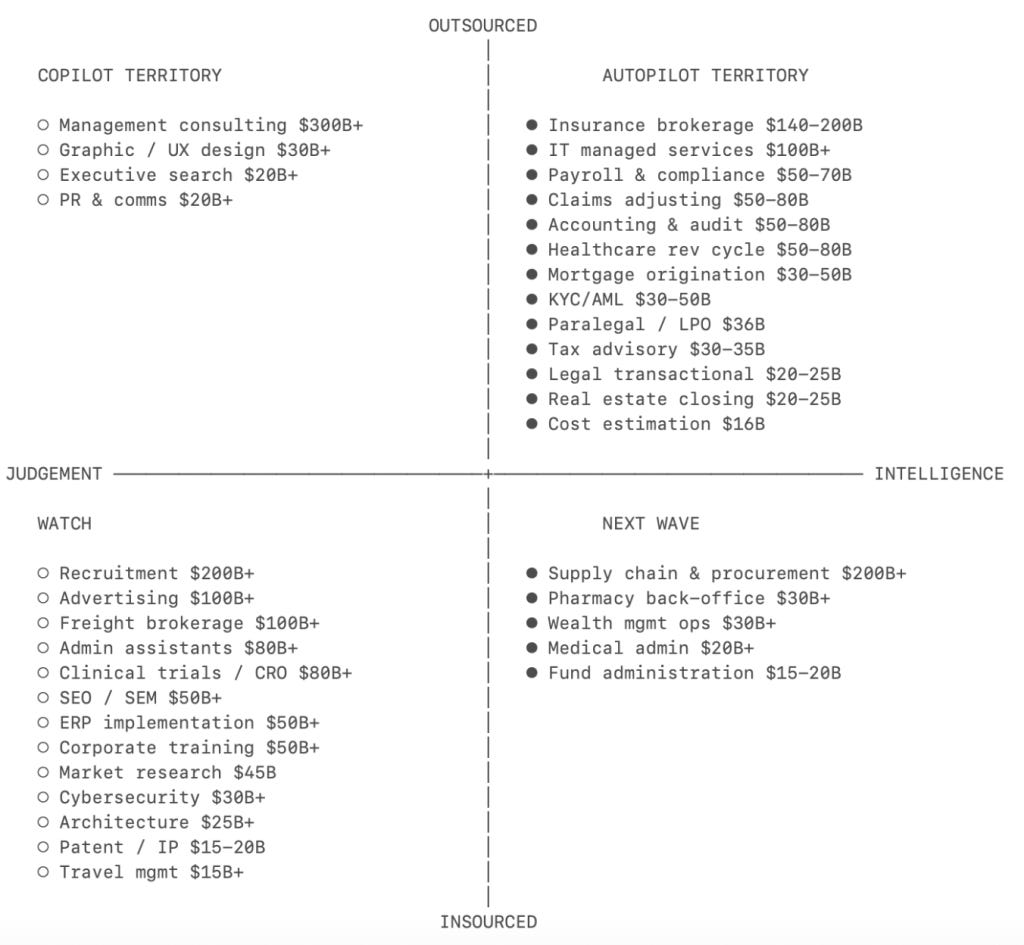
Côté’s second claim lands harder than the first: “Software investing is over. Software was never more than 2% of the economy anyway.” The trillion-dollar software franchises are already public and obvious. Betting on a “next generation” of $1T pure-software names is betting on 2% of GDP to keep minting the outcomes that a saturated category already produced.
This reframes the Sequoia thesis as a fight over the wrong prize. Sequoia is right that the labor budget dwarfs the software budget, which is exactly why “sell work” sounds bigger than “sell seats.” But labor-as-software still lives inside the services trap from section one: it captures labor spend only until the model absorbs the task. Côté’s move is to skip the trap entirely and go where the spend is both enormous and physically defensible. As he puts it, “the hard business of technology lies ahead, which is remaking the physical world. The other 98% of the economy.”
The number that reframes everything is his growth claim: “Almost all economic growth is in the future.” Software’s growth is largely behind it; the category matured and the winners were crowned. The physical economy’s AI-driven growth has not started. If you are allocating for the next decade rather than trading the last one, a mature 2% category is a strange place to concentrate.
Hardware itself has not suddenly become as scalable as software. What has changed is the intelligence controlling the hardware: AI models, simulation, digital twins and more adaptable robots can be developed once, improved with data and reused across multiple machines and factories.
That means a company can increase output without increasing engineers and workers at the same rate, because one team can supervise more equipment and software updates can improve an entire installed fleet. The economics become more scalable, but materials, energy, machinery, maintenance and deployment costs remain.
3. The five $10T atoms markets
Côté names the destinations explicitly: “Chemicals, Metal, Energy, Transportation, Healthcare.” His scale claim is the part investors keep underweighting: “Each market is 10x the total size of all software. These are not $1T company valuations, they are $10T gross annual revenue markets.”
The unit distinction matters. A $1T valuation is a stock-market number for a handful of names. A $10T gross annual revenue market is the recurring flow of money through an entire sector every year: the actual dollars changing hands for chemicals, steel, electrons, freight, and care. Côté is telling you to stop hunting for the next trillion-dollar market cap and start hunting for a slice of a multi-trillion-dollar annual revenue river that has never had software-grade tooling pointed at it.
He is careful to include the reason these markets have been ignored, giving two in his words: “Lower annual growth rates” and “Lower leverage on value production.” Chemicals and steel grow at GDP-like rates, not SaaS rates, and each unit of value historically required proportional physical input, with no software-style leverage where one engineer serves a million users at near-zero marginal cost. That is exactly why generalist VCs skipped them, and exactly why they are uncontested now.
The bet is that AI plus robotics breaks both constraints at once. Remove the growth ceiling by unlocking demand that was capped by cost and capacity, and add software-style leverage by letting a handful of models and autonomous machines run processes that used to require armies of operators. Do both, and a GDP-growth, low-leverage industry starts to behave like software while sitting on a revenue base ten times software’s size.
For a builder, the actionable move is to pick one of the five and go one layer deeper into a single process inside it, not the whole sector. “Chemicals” is not a strategy. “AI-controlled continuous-flow synthesis for one class of specialty chemical” is a wedge into a $10T sector where nobody has your tooling.
4. How a $400B industrial process gets software-like margins with AI plus robotics
The most quotable and most testable claim Côté makes is the unit-economics one: “You will see software like margins and growth rates in physical industries where the TAM for a single industrial process is $400 billion, where demand is extremely price sensitive and the addressable market is massively under-estimated.”
Unpack “extremely price sensitive,” because it is the engine of the whole thesis. In physical markets, demand is capped by price. When AI plus robotics collapses the cost of a process, you do not just win share, you unlock demand that never existed at the old price. That is how a mature-looking market turns out to be “massively under-estimated”: the visible TAM was measured at today’s cost, and cutting the cost expands the market underneath you.
The software-like margin comes from replacing per-unit human labor with a fixed model-and-robotics cost that then serves rising volume at near-zero marginal increase. That is the same leverage curve that made software gross margins 80-plus percent, now applied to a process that currently runs at industrial margins because every unit of output needs proportional human operation. Automate the operation and the margin structure migrates from steel toward software while the revenue base stays the size of steel.
The tell that this is real and near sits in Côté’s own most recent posts. On July 28 he noted “the kind of visual models you can fit on a drone” (@Andercot): the concrete detail that the perception models needed to run physical processes now fit on cheap edge hardware. The bottleneck was never the ambition, it was models small and cheap enough to sit on a machine in a plant, on a truck, or on a drone. That constraint is lifting now.
The builder takeaway: underwrite the demand unlock, not just the cost cut. Model what happens to volume when your process cost drops 40%. If that cut unlocks 3x the demand, you are not competing for a fixed pie, you are creating the market and you get to price it.
5. Who is already building the atoms version: ATOMS, hard tech, defense, energy, and the playbook to copy
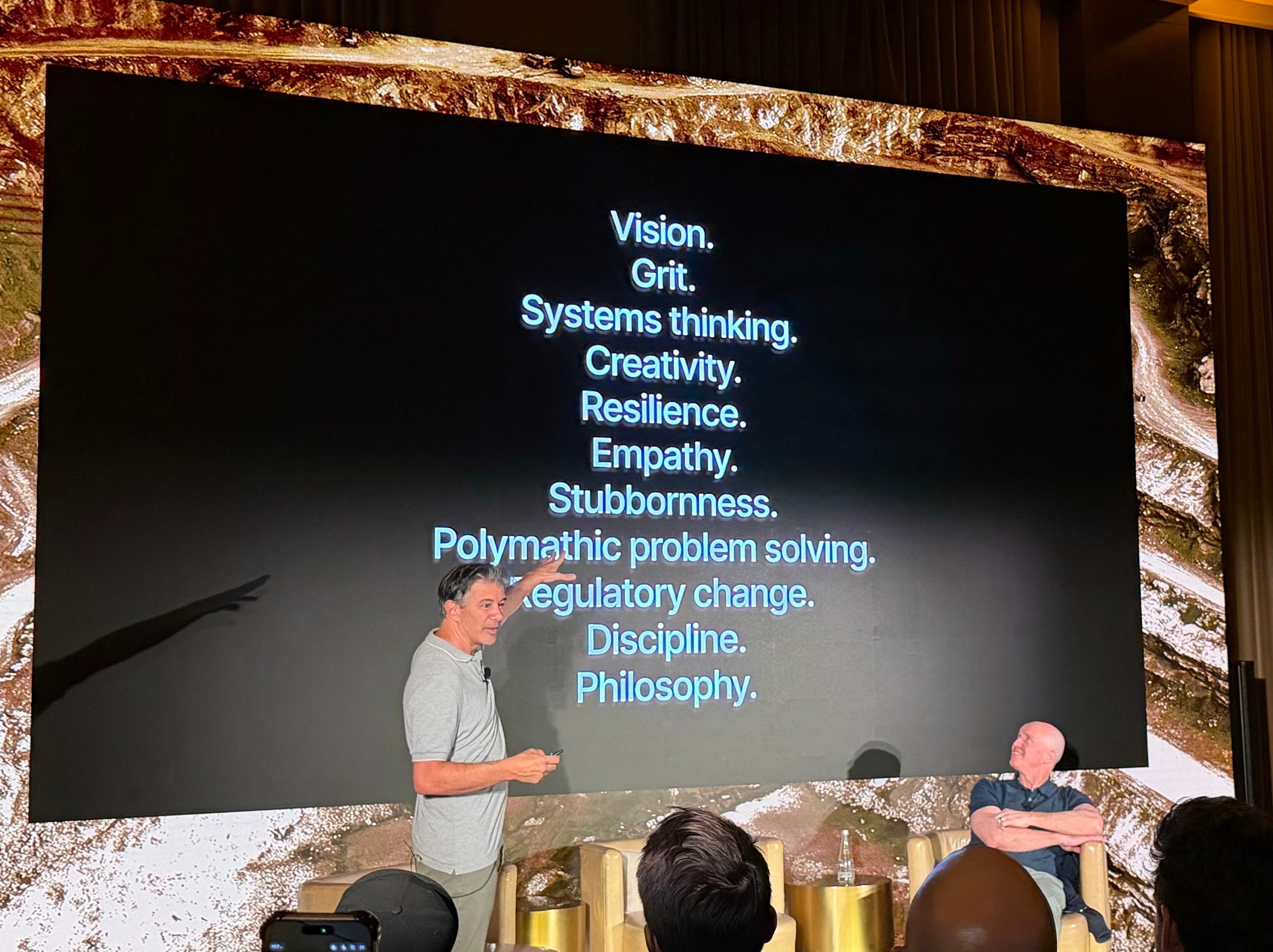
The bits-to-atoms trade is not a forecast; capital is already rotating. Travis Kalanick’s ATOMS is the loudest signal that a top-tier operator is treating the physical economy, not another app layer, as the next platform. Around it sits a widening cluster: industrial AI applying models to plants and supply chains, hard tech building the machines, defense tech where physical autonomy gets funded and battle-tested, and energy, the input every other atoms market depends on.
Côté’s own timeline puts him inside the perception-and-robotics layer of this wave. His July 28 note on drone-scale visual models, referenced above, is a direct read on where the buildable edge is right now: put capable models on cheap physical hardware and point them at a process.
Travis Kalanick's direct quote on what he's building:
"CPU manipulates bits to compute information. Robots and AI manipulate atoms to compute the physical world."
That's not a metaphor. It's a thesis.
Uber was the proof of concept — touch glass, car arrives. Atoms as a programmable layer. Kalanick calls it "sci-fi at the time." It shipped in 2010.
His new company, Atoms, is the follow-through: take that same logic from ride-sharing into every factory, warehouse, and supply chain that still runs on unoptimized physical processes.
The framing matters because it changes the competitive landscape entirely. If the physical world is just an atoms-based computer, then robotics isn't automation — it's infrastructure. The same reclassification that made servers into cloud computing and phones into platforms.
Kalanick's been thinking about this since Uber. That's a long time to sharpen a thesis before building the company around it.
Côté raises the cultural stakes to make the urgency concrete: “Walk through the world with nostalgia and appreciation, you are seeing the last time in history where everything that has been designed and made was wholly made by humans” (@Andercot, July 28 2026). Strip the poetry and it is an investment thesis: the transition of physical making from wholly-human to AI-and-robot-assisted is happening now, which means the winners in each atoms vertical are being seeded in this window.
The playbook to copy from the ATOMS-style plays is consistent. Pick one physical process. Own the machine or the deployment, not just the model, so the foundation-model owner cannot commoditize you. Sell into a price-sensitive market where a cost cut unlocks new demand. Keep the defensible asset physical or regulated, the exact opposite of the services wrapper that trains its own killer.
Defense and energy are the two verticals where this is furthest along, because both fund physical autonomy directly and both are politically insulated from the “just wrap a model” competition. If you want to see the atoms playbook running with real budgets today, those are the two rooms to be in.
6. The builder and investor moves: what to start, back, or partner on before this is consensus
Start here if you are building: pick one industrial process inside chemicals, metal, energy, transportation, or healthcare, and own a physical or regulated asset in it, not a workflow on top of a model. The section-one test is your filter. If a year of your usage would train a foundation model to replace you, do not build it. If your moat is a deployed machine, a plant contract, a license, or a distribution channel the model cannot touch, build it now while the category is uncontested.
Back this if you are investing: companies whose defensibility is physical and whose demand is price-elastic, so a cost cut expands the market instead of just shifting share. Underwrite the demand unlock Côté describes, the “massively under-estimated” addressable market that only appears once cost drops. A $400B single-process TAM with elastic demand and a physical moat is a fundamentally better shape than a labor-as-software play sitting inside a $10T sector but exposed to model commoditization.
Partner on the sensing-and-robotics layer that every atoms vertical needs. Côté’s repeated point about “visual models you can fit on a drone” (@Andercot, July 28) marks the enabling technology: edge-deployable perception models are the shared infrastructure for chemicals, metal, energy, transportation, and healthcare automation alike. If you cannot own a full vertical, own the perception stack that all five need to run.
The one thing to avoid: the pure AI services company whose entire value is completing a knowledge task with a wrapped foundation model. That is the trade Sequoia is talking the market into, and it is the exact business Côté’s one line dismantles. Every task it completes is a training example for its executioner, and the timeline to obsolescence is set by the model owner.
The move this week: take one AI services idea you were excited about and rewrite it as an atoms play. Same customer pain, but instead of selling the completed knowledge work, ask what physical process sits underneath it, whether a model on cheap hardware could run that process, and what asset you would own that the foundation model never can. Answer all three, and you have found a business on the right side of the bits-to-atoms line before it becomes consensus.
What do you think?
Cheers,
Guillermo
>Côté’s conclusion is that “every possible niche where you can use AI to do something better eventually becomes a niche occupied by AI.”
To become true it should be based on assumption that AI is better than human in every niche where humans use AI. But it's far from reality.
AI services aren't new software yet. Sustainable AI biz models produce output which becomes more expensive than human labor. Humans get wages to cover cost of living. Paid agents should get wages to cover token costs. Same model but AI is yet to deliver proven ROI. AI service price should cover seller costs but they easily exceed visible service value. The surplus is not clear now with raising token consumption = costs. AI subscriptions do provide value compared to API calls but they are subsidized = not sustainable as biz model. Closed loop))