



A few days ago, Sequoia partner Julien Bek made a very big claim:
The next $1 trillion company will be a software company masquerading as a services firm.
At first glance, that sounds like one of those bold VC one-liners people repost because it sounds smart.
But the more I looked into it, the more I thought:
wait, this might actually be one of the most important ideas in AI right now.
Because if this is true, then a huge number of founders are building the wrong thing.
They are building copilots.
They are building tools.
They are building software that helps someone do the job better.
But the real opportunity may be much bigger:
build the company that does the job itself.
Not software for accountants.
The company that closes the books.
Not software for lawyers.
The company that reviews the contracts.
Not software for insurance teams.
The company that handles the claims.
That is the shift Julien is pointing to.
In his piece, he argues that if you sell the tool, you are stuck competing with better models every few months. But if you sell the work, every improvement in AI makes your product faster, cheaper, and stronger.
And there is another reason this idea matters so much:
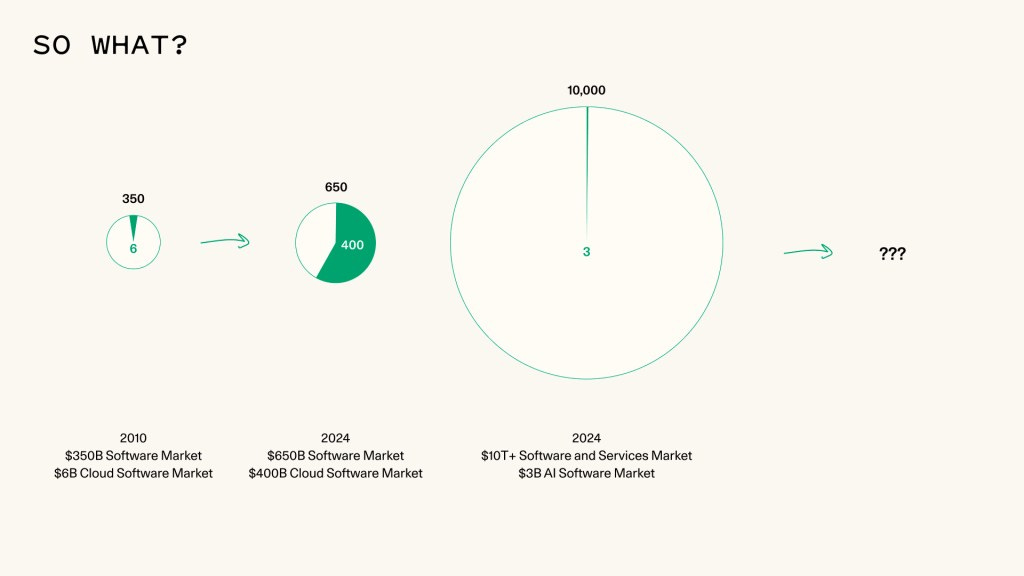
for every $1 spent on software, around $6 is spent on services.
So the real prize may not be the software budget at all.
It may be the labor budget.
What makes this even more interesting is that this is not a totally new idea.
For years, investors have tried to find ways to turn service businesses into something more scalable and more software-like.
That is part of why strategies like rollups have become so attractive: the belief that fragmented service industries can be consolidated, improved, and made far more efficient.
What AI changes is the magnitude of that opportunity.
Before, software could help professionals do the job better.
Now, it is getting close to doing meaningful parts of the job itself.
That is the real reason Julien’s thesis feels so important right now.
Not because nobody has seen the opportunity before.
But because this may be the first moment when the technology is finally good enough to make it work at scale.
So I decided to go deeper.
I looked into the companies Julien and Sequoia point to as early examples of this shift, what they are actually doing, how they are doing it, and why some of these categories may produce massive companies over the next few years.
In this deep dive, you’ll learn:
Who is already doing this: 5 founders building right now (mentioned by Sequoia)
How these companies are structuring the model so customers trust them
Where the biggest opportunities still are right now
This is the newsletter that surfaces what’s really happening in the AI market before it hits the front page. Every week you’ll get two things, fast:
What’s happening now (and where the money’s headed).
Who’s already building it (so you can invest, partner, or steal their playbook).
Each issue is short enough to read with your morning coffee but dense enough to move your roadmap.
However, most of the content from this newsletter will be only accessible to the paid subscribers.
If you are serious about building or investing in AI, you can subscribe here:
