


In May last year, I wrote “Why the McKinsey of AI is the biggest opportunity right now.”
The core argument was simple: while model builders were burning billions and AI tools were still searching for product–market fit, consulting firms were quietly minting cash by turning AI anxiety into paid transformation projects.
The Big 4 were compounding GenAI revenue at triple-digit rates, and the mid-market gap alone looked like an $18B opportunity.
That piece resonated because it explained why the opportunity existed.
Over the past weeks, a series of disclosures, case studies, and interviews have made something clear: McKinsey & Company is no longer just advising on AI. It is running on it.
McKinsey’s CEO says the firm has about 40,000 employees and is using roughly 25,000 AI agents internally.
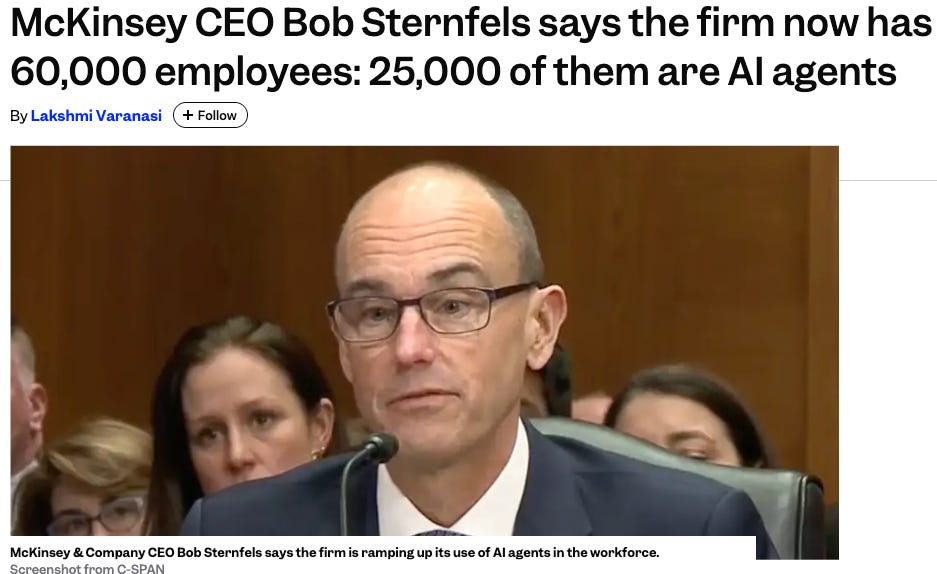
They’ve also said they want every employee to have at least one agent supporting their work, and they’re shifting parts of their business model toward outcome-based engagements rather than pure fee-for-service.
If you strip out the PR, the model is simple: they’re standardizing how work gets done and using software (agents) to increase output per person.
You can copy the same approach at a smaller scale by doing three things well: pick a narrow problem, build a repeatable delivery system, and price it in a way that aligns with results.
McKinsey now talks openly about:
an internal genAI platform used by most of the firm
thousands of AI agents treated as real delivery capacity
a production-grade AI stack used across client engagements
a shift away from fee-for-service toward underwriting outcomes
This newsletter is a teardown of what they actually built, which tools they use, and what each one is used for, based only on what McKinsey and major outlets have publicly disclosed.
What you’ll learn in this issue
What Lilli actually is
McKinsey’s internal genAI platform, what data it runs on, how consultants use it day-to-day, and why it became the foundation of their AI strategy.7 tools you can contract to build your company’s Lilli (AI Intelligence)
How McKinsey productionized AI delivery
The role of QuantumBlack, the Horizon stack, and why McKinsey built an internal “AI factory” instead of relying on one-off projects.Which concrete tools McKinsey uses — and for what
Lilli, QuantumBlack Horizon, MLRun, Iguazio, Frontline AI, Value Maximizer, and how each maps to a specific problem (knowledge access, MLOps, claims triage, supply chain optimization, real-time analytics).Real client cases, not hypotheticals
Insurance claims triage, multilingual customer feedback, real-time performance analytics, and product design optimization — including what part AI actually played.How AI changed McKinsey’s org design
Why they invested in data stewards, how they measure output quality, how they pushed adoption internally, and why “working with AI” is now part of recruiting.Why this matters for builders and investors
Because McKinsey isn’t inventing a one-off advantage. It’s standardizing a model that others can copy — especially outside $100M+ transformation deals.
If the previous “McKinsey of AI” piece explained why this market exists, this issue shows what the leading player actually did once the opportunity became obvious.
And that’s the part most people never get to see.
—
Guillermo
Sponsor The AI Opportunity & get your product in front of thousands of founders worldwide? Reach out to g@guillermoflor.com
Trending right now: How Base44 was bootstrapped and sold for $80M in 9 months
