


a16z is invested in 1,600 companies and puts well over 80 percent of them right in the Bay Area, and it just turned that into the unfair advantage behind a new school.
the one elite customer, the bundle they refuse to cut, and the incentive alignment that colleges structurally cannot match. What you get is not an education debate, it is a reusable lesson in how they found product market fit for a thing most people said couldn’t be built.
Most people are getting the read wrong: this is not a16z building a college competitor.
It is a16z productizing its own unfair advantage (portfolio access, employer relationships, San Francisco osmosis) into a hiring and dealflow funnel, and openly inviting Harvard to copy the model because the moat is the assets, not the idea.
Watch how they run the YC playbook on education, and you will see why their narrow predecessors failed.
In this article you’ll learn the Horowitz Andreessen Academy Playbook (and their view of the future post AI)
The one customer with burning desire, and why narrow alternatives failed
AI is this era’s Industrial Revolution, and the training built for the old one is obsolete
The bundle they refuse to skip: residential SF, elite demand, and direct company access
No billion-dollar idea at 18? Join someone who has one
People skills come from reps, not lectures: the osmosis engine
Why it has to be San Francisco: the city is the campus
For-profit and separate on purpose: aligning incentives so the student is the only customer
From push to pull: every curiosity becomes a shipped project
The real constraint isn’t execution, it’s picking the right problem and failing right

1. The one customer with burning desire, and why narrow alternatives failed
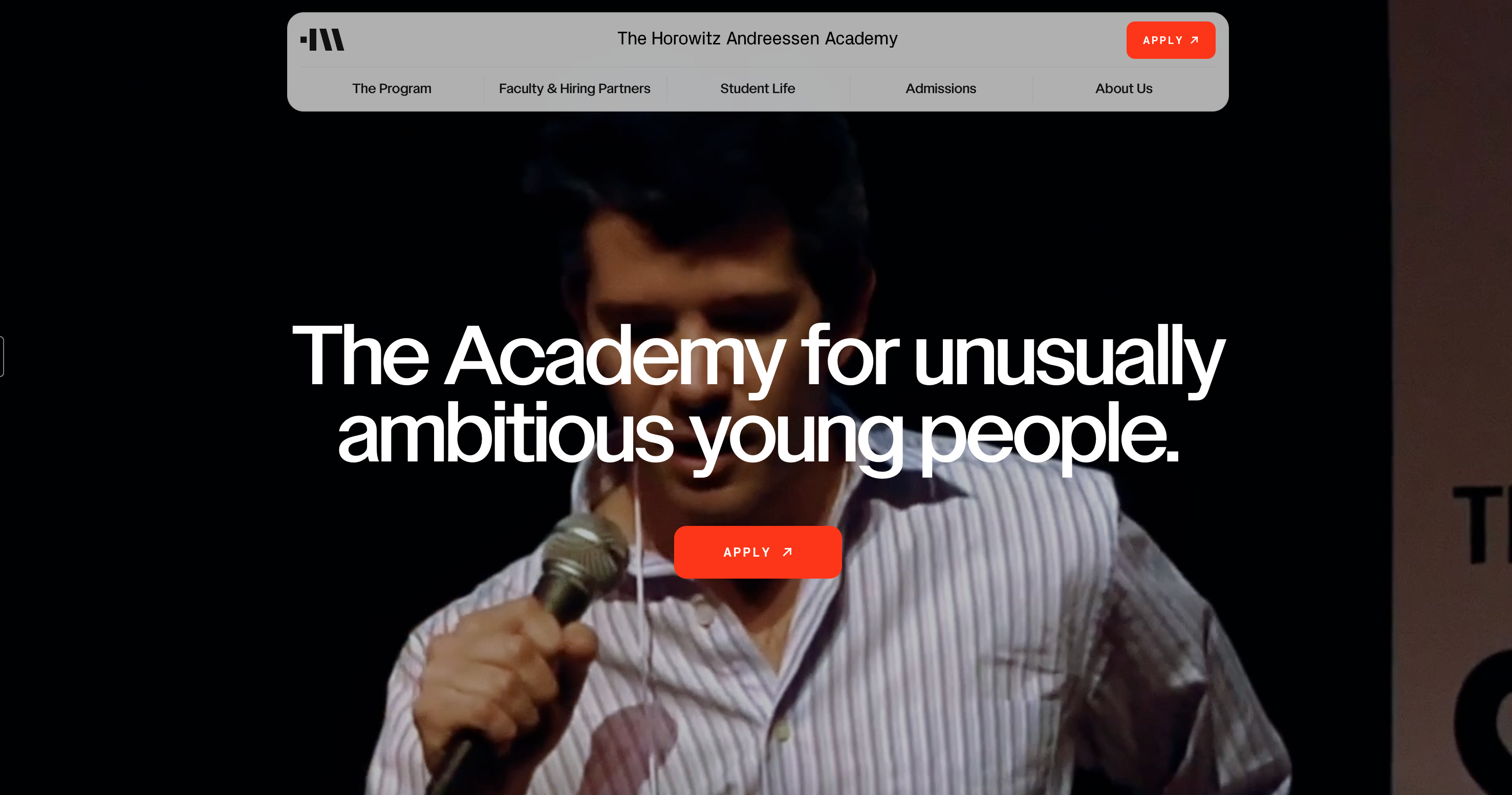
Every startup answers one question first, and the Horowitz Andreessen Academy (HAA) answers it before anything else: who is the customer, and how badly do they want this. Biyani answers in plain founder language. “You need a very very unique specific customer who has a burning desire for your product,” he says, and he spent six months confirming that customer exists: a generation of young builders “who are just fired up about creating things.” That is the whole thesis. Not “students,” not “18-year-olds,” but the narrow slice that already knows it wants to build.
Why did every previous college alternative flop? The panel’s diagnosis is the sharpest founder lesson in the conversation. a16z has backed several efforts in this space and watched them fail to cut through. Horowitz’s verdict: “I think they focus a little bit too narrow. You know, college is, of course, a bundle.” The failure was not the idea. It was picking one thin layer of a product that has to ship whole: job training plus education plus status and credential plus brand plus, as he insists, fun. Deliver a course and skip the credential, or the credential and skip the fun, and you have shipped a feature, not the product.
Horowitz also draws the line around who college still serves well. It “works really, really well if you want to be a scholar,” he says, but “it’s a little bit of a weird proposition if you just want to get a job or you have an idea to start a company.” HAA is not trying to be college for everyone. It picks off the exact customer college underserves and builds the entire product around a different verb: doing, not studying about doing. “You kind of want to learn how to do it as opposed to just study about it.”
The move is textbook. Find the customer with the burning desire, build the whole bundle, and let the incumbent keep the rest of the market. Predecessors died because they inverted it: broad customer, narrow product.
2. AI is this era’s Industrial Revolution, and the training built for the old one is obsolete
a16z’s entire macro bet is that the training infrastructure is fitted to a world that is ending. Horowitz walks the history: the modern university exploded in the US to feed a corporate world that did not exist in 1700, when it was “a farm world.” Literacy, math, and structured learning became the entry requirement for a new economy, and universities scaled to manufacture that input. That was the right product for the Industrial Revolution.
AI, they argue, is a reset of the same magnitude. “We’re hitting the AI revolution now, which is going to be, you know, in our estimation, as transformational in terms of jobs, the way jobs are done, the kinds of jobs that are available, and so forth, as the Industrial Revolution was to the agricultural kind of society that came before it,” Horowitz argues. The corollary is the whole reason HAA exists: “the idea that the training for the industrial revolution is going to map into the AI revolution is probably not perfectly.” The old input spec no longer matches the new economy’s demand.
That is why the format changes, not just the content. Instead of “being in lectures for five hours a day or eight hours a day,” the model shifts to “more contained instruction and, you know, more time with the tools, more time learning on an individual pace with AI.” The lecture was optimized for broadcasting scarce knowledge to a room. When every student has a tool that answers the lecture’s questions, the classroom hours become the least valuable part of the day.
So read the whole thing correctly. This is not a16z arguing college is dead. It is a16z running a textbook PMF playbook on education: find one elite customer with a burning desire, deliver the full bundle every narrow competitor skipped, and align incentives so the student is the only master. AI is the reason the bet is timely, but the reason it works, and the reason the predecessors failed, is the playbook, not the moment.
3. The bundle they refuse to skip: residential SF, elite demand, and direct company access
The bundle is the moat, and Biyani spells out its non-negotiable components. “You need to have it residential in San Francisco. You need to make sure that it’s connected to the employers who employ the best people.” Miss either and you are back to being one of the narrow efforts that failed. His estimate of how rare this is: “there’s probably only two or three people who’ve ever even tried to deliver that bundle in the last, you know, let’s say 50 years.”
Elite demand is the component competitors cannot fake. Biyani draws the distinction carefully: HAA has “a very clear demand and also that that demand is elite.” Not fringe, not politically loaded, but the students who “are going to employ thousands or hundreds of thousands of people in the future” and “raise a billion dollars for their company eventually.” When your customer pool is the future employer class, the credential signal is automatic. That is the “status and brand” layer of the bundle a course-only competitor can never manufacture.
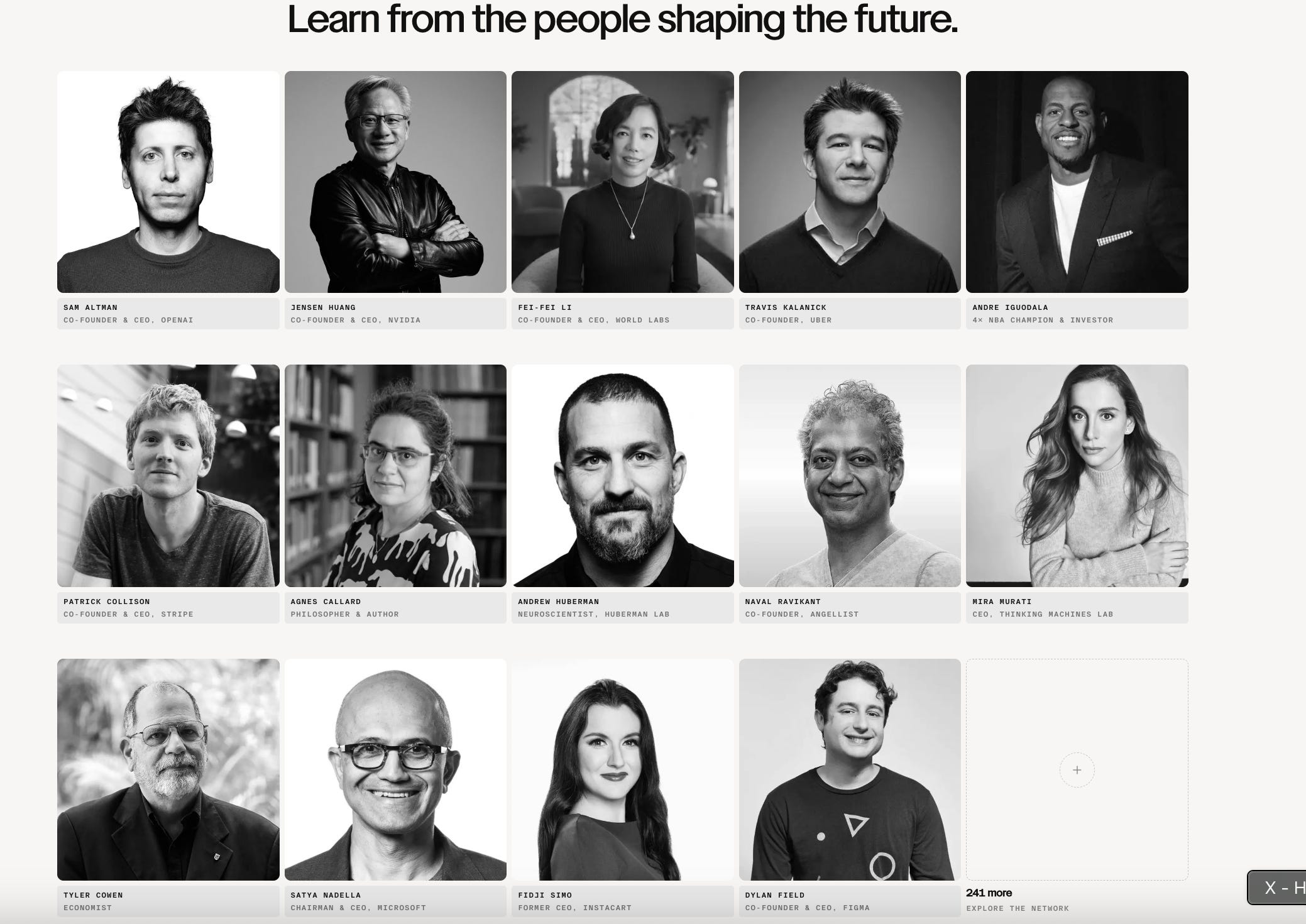
Then comes the piece only a16z can deliver: direct company access. “Here you’re going to have access to work at companies, internet companies like Databricks, NVIDIA, Stripe, dozens of others,” Biyani says, describing immersion in “the a16z sort of cinematic universe.” Databricks, NVIDIA, and Stripe are named as examples, with “dozens of others” drawn from the a16z portfolio. Horowitz is candid that a16z is “working to make those partnerships kind of explicit around the graduates.”
This is where the “education play” framing breaks. The bundle is a hiring and dealflow funnel wearing a school’s clothes, and it is defensible because the assets, 1,600 portfolio companies and a roster of the most sought-after employers in tech, are the exact things a university cannot buy.
4. No billion-dollar idea at 18? Join someone who has one
The most useful advice in the conversation is a correction to the founder fantasy. Horowitz is blunt that the founder compelled by a unique insight is real but rare: “if you’re young and you see something that you go, oh my God, I think I’m the only one who really understands this and it’s compelling me to build a company, then that’s, you know, that’s phenomenal. That’s Mark Zuckerberg.” Then the honest part: “also a rare one.” He adds that he “didn’t have a great idea when I was 18,” which takes the pressure off the myth.
For everyone else, the default move is to join early. Horowitz’s example lands because the counterfactual is famous: “all Zuck’s roommates from Harvard who didn’t go to Facebook with him really regretted that because he kind of invited them all to be employees.” The regret is the whole argument. Proximity to a compelling insight, even someone else’s, beat waiting for your own. His own foundation came the same way, joining Silicon Graphics, where he “saw what that was and how you can really change things,” which “built a foundation for the rest of my career.”
Biyani’s macro data reinforces why this is a placement problem, not an idea problem. He and Andreessen commissioned research finding Gen Z is “the generation that has the highest variance and fragmentation across the board,” which means the rare 18-year-old already building startups now exists in real numbers, and the value is aggregating them in one place.
The reframe matters for anyone chasing a founder identity: if you do not have the billion-dollar insight, the mistake is settling for the million-dollar one instead of joining the person who has the bigger one and earning the reps.
5. People skills come from reps, not lectures: the osmosis engine
The skill AI makes most valuable is the one you cannot download, and Biyani is explicit that it is manufactured by environment, not instruction. “One of the core tenets of developing a skill like that is osmosis,” he says. “You need to immerse the student in the social environment in which these, which the humans are.” The design decision that follows is deliberate cohabitation: students share the office “with other companies and individuals and projects and co-ops and internships that are with the quote-unquote adult world.
Real projects with real dependencies do the forcing. Biyani’s example: if you are building a new type of robot dog and need a specific chip, “you don know how to write a cold email You going to have to learn.” The people skill is acquired because the project cannot ship without it. His verdict on the alternative is direct: “let me sit in a lecture talking about negotiations. Like, that’s not how you develop people skills. You develop people skills because you’re doing something you really care about and you need to get everyone on board.”
Horowitz names the specific muscle most people never build: genuine curiosity about the person in front of them. The skill he tries hardest to impart at the firm is starting with who someone is, “where’d you grow up? Where are you from?” rather than transacting. His bet is that AI, by pulling people off screens and handling the machine work, frees them to “really deal with people where there’s going to be just tremendous value.
”
Stack the three inputs, osmosis plus a supportive peer network plus project-based work, and Biyani argues they “combined will dramatically accelerate people’s skill development.” The lecture was never going to produce it. The reps are the product.
6. Why it has to be San Francisco: the city is the campus
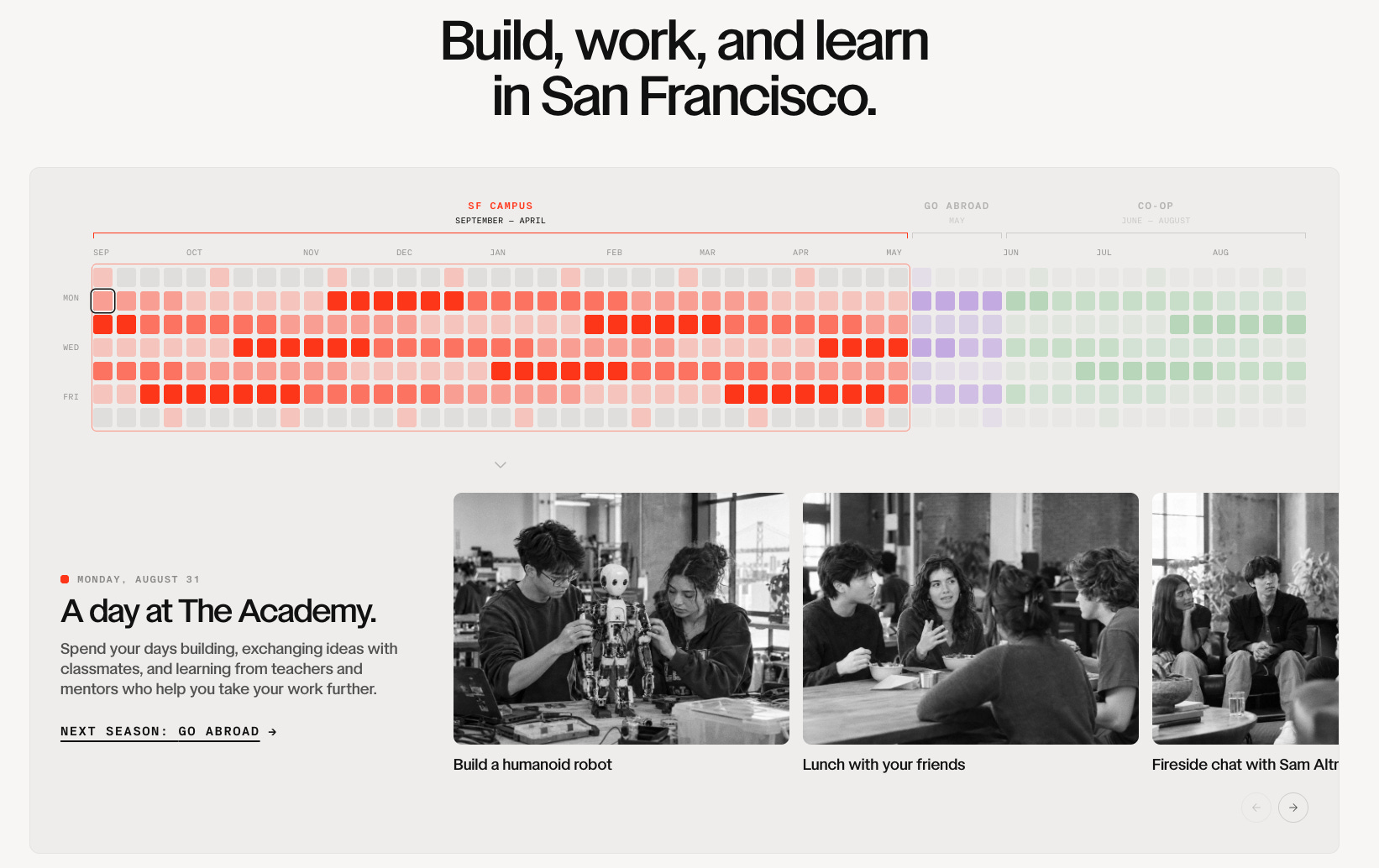
Location is product design, not logistics, and the argument rests on the same asset math as the bundle. “We’re connected to so many companies, but probably, you know, well over 80 percent of them are like right in this area,” Horowitz says. That single number decides the geography. If the funnel’s endpoint is the portfolio, and the portfolio is concentrated in the Bay Area, then placing the school anywhere else breaks the proximity that makes it work.
That math reframes the campus entirely. “San Francisco is your campus, right? The campus is not just the walls within the school, but it’s the entire city,” Biyani says. Horowitz adds the structural reason it has to be here: it is “where most companies, great companies in America get started,” and the people who know how to do that “just a huge majority are here in California.” He contrasts it with his own New York education, where “most of the people who came out of that went into financial services.” Geography routes ambition

.
Harder to copy is the cultural asset. Biyani argues San Francisco pairs two traits that rarely coexist: it “embraces failure” and pays it forward on a “super high trust culture,” while remaining “super ambitious.” His phrasing: “It’s a rare combination. It’s very hard to get right.” That combination is the environment the osmosis engine runs on, and it is the one input no rival school can relocate.
Placing the school here is not a preference. It is the physical precondition for the funnel, the culture, and the osmosis to function at once, which is why the city itself is the product.
7. For-profit and separate on purpose: aligning incentives so the student is the only customer
The corporate structure is the cleanest expression of the PMF logic: a standalone for-profit company, deliberately not a piece of the firm. Horowitz’s reasoning splits in two. First, ambition: the model “it’s very interesting for music. It may be interesting for medicine,” because “every profession is undergoing a massive change,” and burying it inside an investment firm “would have limited its ambition quite a bit.”
Second, and more important, incentive alignment. Biyani states the design constraint that every failed education product violated: “the customer has got to be the student. And right now, sometimes in certain institutions, there’s kind of they try to serve too many customers and it kind of ends up being this disjointed product.” Universities serve alumni, donors, parents, rankings, and the student ends up somewhere down the list. HAA collapses the list to one.
Enforcing that is the profit motive itself. “The profit motive forces us to deliver to the customer,” Biyani says, “and our job is at the end of the day is to make sure that young people who attend the institution go off and do great things because that creates the brand, that creates the flywheel, that allows us to continue to stay in business.” Student outcomes are the only revenue engine, so serving anyone else is a distraction the business cannot afford.
And the moat is not secrecy. Horowitz’s invitation is explicit: “please, Harvard, copy us. Please, everybody copy us.” He can say that because the defensible assets, the portfolio, the employer relationships, the SF concentration, do not travel with the idea. The idea is free. The bundle is not.
8. From push to pull: every curiosity becomes a shipped project
The assessment redesign is where “learning by doing” gets operationalized. Biyani frames it as a shift from a push model to a pull model: away from “these grades and all this stuff you have to cram” toward “what are you naturally curious about? And what can you go build or pursue in that space?” The grading criterion changes accordingly. “We want to be more oriented around, oh, did you build something interesting? Then, oh, could you like memorize these questions? Because look, we do have tools that can answer those questions very well now.”
Stanford cryptographer Dan Boneh supplies the sharpest tactic, and it resolves the AI-in-the-classroom debate outright. His two options, per Horowitz: “You can ban it. And by the way, that won’t work. Or you can make the problem so hard that you can’t solve them without AI.” The result Boneh is seeing: “I’ve got students solving things that no student in history could have ever solved.” Banning the tool preserves an obsolete test. Raising the difficulty until the tool becomes necessary produces work that was previously impossible.
Pull also legitimizes interests that are not obviously vocational. The example the panel keeps returning to: don’t have students answer test questions about calligraphy, have them “learn enough calligraphy to write an Islamic poem, you know, beautifully displayed in the academy.” Every curiosity gets reframed into an output, which Biyani argues is the only reliable way to actually acquire a skill, because “It’s a very hard to learn most skills if all you’re doing is cramming for a test.”
Push produces recall. Pull produces a portfolio. When the tools can ace the recall test, the portfolio is the only assessment left that means anything.
9. The real constraint isn’t execution, it’s picking the right problem and failing right
Here is the line that should change how a founder spends their next year: “because the tools are so good, our resources are so good, it’s easier than ever to do something once you know what you want to do. And so the constraint often comes on what’s worth working on.” Execution used to be the bottleneck. Now the bottleneck is judgment about the target. Everything HAA is designed to teach, the osmosis, the projects, the exposure to the real world, is aimed at that one relocated constraint.
You find the right problem mostly by accident, which is why exploration beats settling. Horowitz argues discovery works “kind of like scientific discovery”: you set out to cure pancreatic cancer and “along the way you find” a different solvable problem that becomes the actual idea. This is the mechanism behind his advice to the idealess 18-year-old: “not settle for the million dollar idea, and instead go and explore more.” Narrow targets foreclose the accidents that produce the big ones.
And this defines the only failure worth having. “To try and fail at a really hard problem, the value is in the learning,” Horowitz says. Not all failure counts: the valuable kind is where “you’ve earned a secret by going out there trying to solve a hard problem and not being able. Now you know why that problem is so hard to solve.” That secret becomes the map to the sub-problems, and it is what HAA says it will grade: “what did you learn by doing?”
Five years out, Biyani’s success metric is downstream of all of it: graduates “who have great careers that they love” or who “has started really interesting companies.” That is the honest tell about what HAA actually is. Not measured in test scores or degrees, it is measured in careers and companies, the same outputs a16z measures its own portfolio by.
For founders, the lesson is not that college is dead. It is that when execution gets cheap, the scarce, defensible skill becomes knowing what is worth building, and the people running the best playbook in venture just built an entire institution to manufacture exactly that.
Hope this was valuable!
If it was, subscribe and share!